

Canada’s auto sector supports more than 500,000 workers and anchors manufacturing communities across Ontario. But as the global car market rapidly electrifies, future jobs and investments will increasingly flow to countries that provide policy certainty and long-term market growth. Canada risks being left behind.
The global shift to electric vehicles (EVs) is already well underway. Global EV sales are projected to reach 23 million in 2026, representing nearly 30% of all new car sales worldwide. Europe is expected to see the fastest growth among major markets, with one in three new vehicles sold projected to be electric next year. China is on track to approach 60% EV market share, while EV sales across the rest of Asia Pacific are expected to grow by more than 50%. Latin America markets are also accelerating rapidly, projected to rise by 45%.
Even without additional policy action, the global EV fleet is projected to grow more than sixfold by 2035, reaching 510 million vehicles worldwide. Increasing EV cost competitiveness alongside stronger vehicle emission standards across major economies is accelerating the global shift away from internal combustion engines.
Canada, on the other hand, has yet to capitalize on this global shift. Policy flip-flops and uncertainty slowed Canada’s EV transition. The federal EV rebate expired in 2024, the Electric Vehicle Availability Standard was paused in 2025 and repealed in 2026, and consumers delayed purchases while automakers were left questioning the long-term direction of the Canadian market.
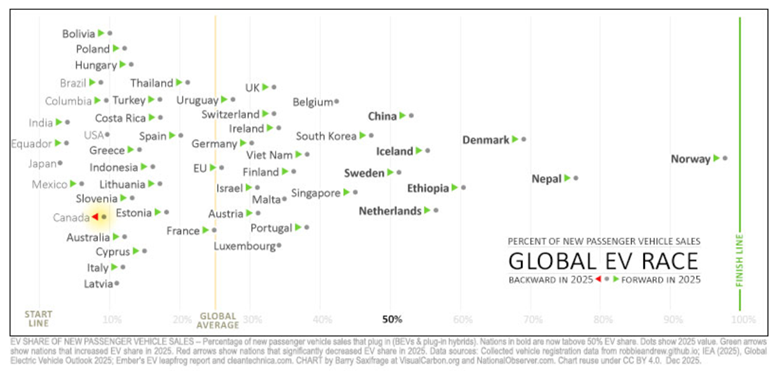
That picture is now changing. With consumer incentives reinstated earlier this year, gas prices climbing and more affordable EVs reaching dealerships, demand has rebounded sharply. Statistics Canada reports a 75% year-over-year increase in EV sales in March alone.
Canada is now at a pivotal junction. The federal automotive strategy released in February dedicated funding to charging infrastructure and domestic EV manufacturing, introduced protections for Canadian auto workers and committed to stronger vehicle emissions standards (VES) to meet the government's goal of 75% EV sales by 2035 and 90% by 2040.
The strategy is a welcome signal, but signals alone do not drive investment decisions. What matters now is whether Canada follows through with durable policy.
A vehicle emissions standard sets a ceiling on how much emissions new cars can emit per mile driven. Automakers can comply in different ways in the near term, including improving gas vehicle efficiency, selling more hybrids and increasing zero-emission vehicle sales. But over time, stronger standards increasingly require a larger share of EV sales to meet compliance. The stringency of the standard ultimately determines whether Canada hits its target or falls short.
To better understand what “strong” looks like, consider the two regulatory poles.
The European Union (EU) has set a vehicle emission standard that will reach 100% battery-electric sales by 2035 — a full phase out of internal combustion engine vehicles. Even the weaker standard (18 g/mile) now under consideration would still be four times stronger than what Canada is proposing. That regulatory certainty has paid off: the EU’s EV market share reached nearly 30% in 2025 (up from 3% in 2019), affordable models have multiplied, and Europe entered 2026 as the fastest growing major EV market, overtaking China.
The U.S. has taken the opposite path, off course and off pace from the momentum of global electrification. The current administration eliminated all tailpipe emission regulations, so any call for Canada to “align with the U.S.” means having no regulation at all. Even reverting to the Biden-era standards would be outdated against today’s global EV growth, and too weak to deliver Canada’s stated sales target. The consequences of U.S. rollbacks are already visible: low EV uptake (7.8% in 2025), few affordable EV options and some of the worst fuel economy scores in the world.
Canada doesn’t need to match the EU’s full phase-out or follow the U.S. into regulatory limbo. A 2035 vehicle emissions standard of 40 g/mile offers a realistic middle ground:
• Strong enough to deliver the government’s 75% EV sales target with high confidence
• Flexible enough for automakers to comply in the most cost-effective way
• Credible enough to attract the long-term investment the sector needs
A clear, credible standard gives industry the certainty it needs to plan, invest and compete globally. Historic uncertainty has already cost us. If we want to attract new investment, and see success, we need to build the consumer base here first, and a strong vehicle emissions standard is that market-building foundation. Manufacturers looking for stable, future-oriented jurisdictions need a reason to choose Canada. A 40 g/mile standard provides that reason.
Canada already has the industrial strategy, growing consumer demand and a global market moving rapidly toward electrification. What is lacks is durable policy certainty. A strong vehicle emission standard would provide that foundation, helping secure investment and position Canada’s auto sector to compete in the global market for decades ahead.