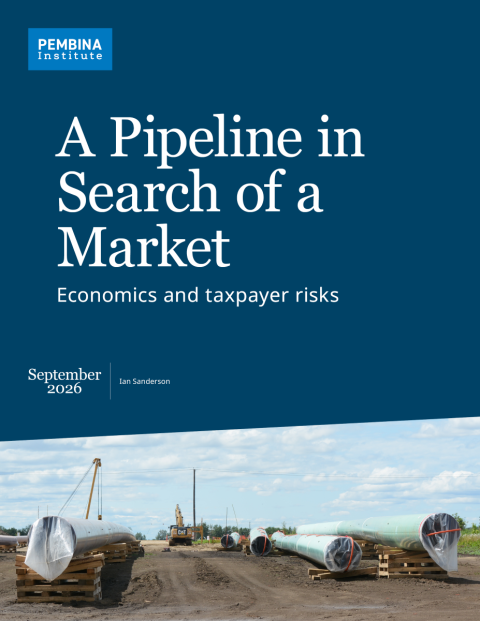
This report assesses whether additional export pipeline capacity from the Western Canadian
Sedimentary Basin (WCSB) is needed and economically feasible, and how a new West Coast
bitumen pipeline would compare with existing and alternative transportation options. The
analysis is situated in the context of renewed policy attention to west coast export infrastructure,
including the Canada–Alberta memorandum of understanding and the Government of Alberta’s
West Coast Oil Pipeline submission. That submission proposes a 1 million barrel per day (mb/d)
pipeline to the British Columbia coast with estimated capital costs of $35.2 billion to $43.7
billion and an ownership structure led primarily by Crown entities.
Key findings
- Supply growth does not justify major new capacity. Alberta Energy Regulator’s
2025 Alberta Energy Outlook and Canada Energy Regulator’s Canada’s Energy Future
2026 point to moderate WCSB production growth led mainly by optimization and
expansion of existing oilsands projects rather than new greenfield development. Filling a
new 1 mb/d pipeline would likely require stronger supply growth and renewed long-term
oilsands investment than current market conditions appear to support. - Existing pipelines and announced expansions appear adequate. Alberta’s
major export pipelines provide more than 5 mb/d of capacity across westbound,
southbound and eastbound routes. Announced optimization projects on Enbridge and
Trans Mountain (TMX) pipelines could add more than 1 mb/d of additional nameplate
capacity at lower cost and with less execution risk than a new greenfield pipeline. - Demand for heavy crude faces structural constraints. Global oil demand growth
is slowing across major outlooks, while demand for refined products made from heavy
crude faces additional pressure. Canadian heavy crude competes in a narrower refining
market, with recent TMX seaborne export data showing meaningful demand
concentrated mainly in China and the United States. - The economic case is weakened by high tolls. Using a negotiated toll framework,
estimated committed-shipper tolls for a new west coast pipeline range from roughly
C$18.66 per barrel (bbl) to C$30.51/bbl across cost scenarios, or about 1.7 to 2.7 times
the current TMX 20-year committed toll. Even under an illustrative lower governmentbacked
return, the lowest estimated toll remains materially above TMX. - Netback analysis does not show a clear producer benefit. In the base case, the proposed pipeline produces a lower estimated netback for delivery to Asia than TMX and remains below the average 2025 WCS price at Hardisty. Sensitivity analysis shows that even favourable pricing assumptions would require substantially lower tolls, stronger Asian pricing or both to consistently outperform existing alternatives.
- The Alberta submission places the risk burden on the taxpayer. The proposed ownership structure would place close to 90% of the capital at risk with government-owned entities, with a minority private partner. If commercially competitive tolls cannot recover the full cost of the project, the gap would likely be absorbed through lower returns, longer payback periods or direct public cost.
These global market forces help explain why a private proponent did not step forward to propose a new pipeline in the first place, and why the recent proposal features substantial government backing. Under current market conditions, the primary challenge facing Alberta producers is not a lack of export capacity, but uncertainty around future demand, prices and the economics of long-term oil infrastructure. Those risks should not be shifted to taxpayers when the private sector is signaling that the project is too risky to finance on normal commercial terms.