
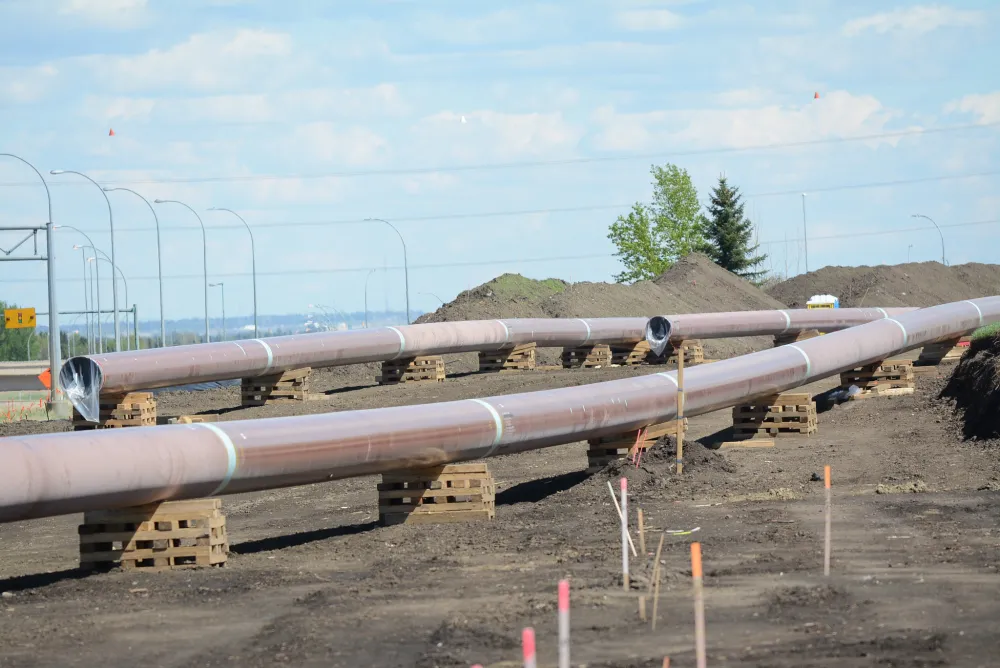
VANCOUVER — The federal and Alberta governments’ plan to publicly finance a new oil pipeline from Alberta to the West Coast will impose tens of billions of dollars in costs onto Canadian families and businesses, which could take decades to recoup, if they are recovered at all, according to a new report from the Pembina Institute.
A Pipeline in Search of a Market, written by senior analyst Ian Sanderson, examines the economic case for the recently announced pipeline project, 90 per cent of which will be owned by Crown corporations and agencies.
“Under current market conditions, the primary challenge facing Alberta producers is not a lack of export capacity, but uncertainty around future demand, prices and the economics of long-term oil infrastructure,” Sanderson said. “Those risks should not be shifted to taxpayers when the private sector is signalling that the project is too risky to finance on normal commercial terms.
“Investing in electrifying our national economy, taking advantage of Canada’s abundant renewable power capabilities, and doubling down on energy efficiency measures will all offer stronger economic returns. This includes connecting our provincial and territorial electricity grids, supporting demand-side management that can reduce costs for families and businesses, and retrofitting homes to make them more efficient.”
Specifically, Sanderson finds that already announced pipeline expansion and optimization projects for Trans Mountain and Enbridge Mainline are sufficient to export the growth in production forecast by both the Alberta and federal governments. Raising oil production to the level required to fill a new pipeline would require tens of billions of dollars in investment in new greenfield facilities, which industry has refused to do since the 2014 oil price crash.
Based on government cost estimates – $35.2 billion to $43.7 billion – the new West Coast pipeline would have to charge tolls that are 70 to 170 per cent higher than the current Trans Mountain pipeline in order to recover its costs. This would add an extremely high transportation cost to oil sands bitumen, which is already relatively expensive to produce.
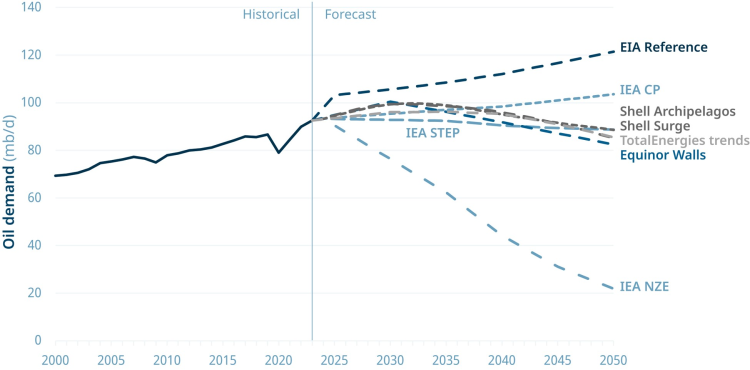
Above all, the long-term outlook for global oil demand is poor. Numerous scenarios, including those published by multinational supermajors, anticipate oil demand reaching a plateau followed by permanent decline within the next five to 10 years. This decline is driven by the rapid electrification of road transport vehicles in Asia, particularly in China, and it will create structural downward pressure on prices. Hou Qijun, chairman of Sinopec – China’s largest refinery business – recently told investors that China’s oil demand probably peaked last year.
The ongoing trade dispute with the U.S. has intensified pressure to diversify Canada's export markets and reduce dependence on a single trading partner. But that urgency makes it more important, not less, to invest our public dollars wisely.
Doubling down on fossil fuel expansion doesn’t only risk taxpayer dollars, it also increases Canadians’ exposure to volatile oil prices that are dictated by global markets. Canadians are keenly aware of the increases to their gasoline and diesel bills this year, despite the fact that Canada produces far more oil than it consumes.
“These global market forces help explain why a private proponent did not step forward to propose a new pipeline in the first place, and why the recent proposal features substantial government backing,” Sanderson said. “If we respect the business know-how of the private sector, then we should closely examine why private investors have refused to pay for new production or export infrastructure.
“While the trade conflict with the United States may appear to bolster the case for a new export pipeline, it doesn’t change the fundamental risks of the project’s high costs and weakening global oil demand. This project is a risky bet for public investment.”
Quick facts
- As a share of private energy investment globally, fossil fuels have fallen from 50 per cent to 28 per cent since 2015, as the private sector moves its capital into renewable energy.
- The Alberta Energy Regulator predicts that from 2025 to 2030, capital expenditures in the oil sands will be about 45 per cent of the 2014 peak.
- For years, global investment in the energy transition has continued to increase at record-breaking pace, hitting $2.3 trillion USD in 2025, up eight per cent from the previous year.
- The International Energy Agency, via its World Energy Investment 2026 report, projects global clean energy investment will again be roughly double that of fossil investment, ($2.2 trillion compared to $1.2 trillion). This gap has been growing over the last decade since clean investment overtook fossil investment in 2016.
Download a copy of A Pipeline in Search of a Market.
Contact
Benjamin Alldritt
Senior Communications Lead, Oil & Gas, Pembina Institute
587-328-1955
Background
Report: Powering Up an Electrification Strategy for Canada
Blog: Don’t gamble Canadians’ money on a risky pipeline
Media release: Full year without private sector interest confirms pipeline is political not economic