
CALGARY — Janetta McKenzie, director of the Oil and Gas program at the Pembina Institute, made the following statement with regards to today’s anticipated announcement from the Province of Alberta and the prime minister's confirmation that there is still no private proponent for the West Coast oil pipeline:
“We don’t know exactly what is going to be announced later today, but one thing has already been confirmed: there is still no private company willing to invest dollars in a brand new West Coast oil pipeline. It’s time to have an honest conversation about this project, and the different — conflicting — motivations that various parties have around it.
“Firstly, the prime minister has been clear that he is focused on opportunities to reduce Canada’s economic dependence on the United States by attracting private investment in big, nation-building projects. This is a noble goal, but the continued lack of private sector interest in this pipeline should ring alarm bells in Ottawa. The federal government needs to focus on commercially viable ways to diversify Canada’s exports.
“Secondly, the premier of Alberta has said she regards this pipeline as a question of ‘whether Canada works as a country.’ For the Government of Alberta, this pipeline is about appeasing the separatist sentiment that continues to rock the province and its economy. Mixing long-term economic decision-making with these sorts of political motivations is something we must guard against as Canadians.
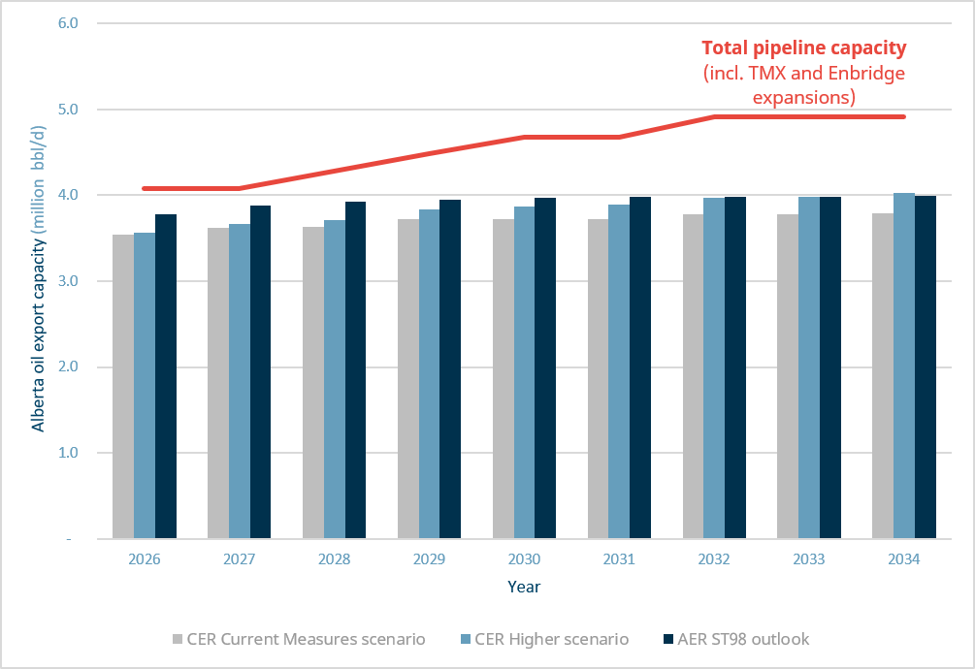
“Thirdly, the oil and gas sector is, quite understandably, only motivated by the possibility of generating returns to their shareholders — and this is where things come unstuck. A brand new oil pipeline to the West Coast is an expensive, high-risk venture; one that is particularly unappealing given the other lower-risk options available to oilsands companies to increase their export capacity. As we have seen over the last year, companies are more interested in optimizing the existing pipelines they have — maximizing the volume of oil that can be put through TMX going west, but also the expansion of the Enbridge mainline going south. Put together, these would offer an additional one million barrels per day of capacity at a much lower cost to both shippers and pipeline companies. Regardless of their words and public statements about a new West Coast pipeline, this is where the pipeline industry continues to focus its actions and its dollars.
“In short, though these three different parties say they want a West Coast pipeline to be built, if the business case were there, a private proponent would have stepped forward by now. For Canadians, this should speak volumes. It’s been more than a year since Premier Danielle Smith said she could secure a private proponent ‘within weeks.’ Since then, the provincial and federal governments have worked to remove any possible obstacle that the industry has suggested exists: dropping the planned oil and gas sector emissions cap, weakening industrial carbon pricing, streamlining regulatory and environmental approvals processes, opening a Major Projects Office; the list goes on.
“Meanwhile, the Government of Alberta has gone to extraordinary lengths to manifest the business case for this pipeline. This includes the unprecedented steps of taking barrels of oil as ‘in-kind’ payments from oilsands companies (as opposed to cash royalties); providing the Alberta Petroleum Marketing Commission a loan of almost a billion dollars to go to Asia in search of buyers for those barrels; and finally contemplating using Albertans’ tax dollars to retool refineries in Japan to process the oilsands’ variety of heavy crude. These are all examples of Alberta taxpayer dollars and royalty revenue being used to artificially create market demand for Alberta’s oil, instead of being spent on vital public services.
“At this point, after all of this government effort and public resources being spent and still no private dollars forthcoming, Canadians have to conclude that investors simply do not believe the idea is good business.
“On this point, industry’s skepticism is well-founded. International oil supermajors like Shell and BP expect global oil demand to enter permanent decline within the next decade, and the price shock of the Iran war has only hastened this by prompting explosive growth in sales of electric vehicles around the world — particularly in Asia. This trend is putting structural downward pressure on long-term oil prices.
“Recent polling shows Albertans believe their economy is over-reliant on oil and gas. Instead, a majority say they want to see new industries, including more renewable energy investment, that can create jobs and prosperity. It is time to properly turn the page on the pipeline debate and for Alberta to formulate a real plan on how to meaningfully change its economy for the secure future Albertans deserve. The natural home for this conversation should be the federal Electrification Strategy, which is a chance for Alberta to build new industries, supply chains, and jobs.”
Quick facts
- In response to the United States’ conflict with Iran, energy rationing is underway across the world, with the International Energy Agency still tracking more than 50 countries — many in the Asia-Pacific region — where governments are urging citizens to take steps to conserve energy, such as limiting use of air conditioning in tropical climates or minimizing daily commutes.
- Other world leaders are also indicating that the conflict has fundamentally altered their view on the risks of oil and gas imports. South Korean President Lee Jae Myung noted in March that “[t]he Republic of Korea as a whole must move very quickly toward renewable energy. Our future will be at serious risk if we continue to rely on fossil fuels.”
- Global demand for oil is even more uncertain than it was 10 years ago. For instance, China’s oil demand is already stagnating, as electric vehicles are replacing gasoline-powered vehicles and renewable energy deployment has accelerated dramatically.
- According to the Alberta Energy Regulator and Canada Energy Regulator, Alberta oil exports are forecast to reach about 4 million barrels/day by 2034, up from 3.5 million barrels/day in 2025. If we take into account the proposed expansions of the TMX and Enbridge pipeline systems, there will be sufficient pipeline capacity for bitumen through the next decade, further weakening the business case for a new West Coast pipeline.
There are other signs of countries rethinking previously approved oil and gas projects in light of the crisis. For example, plans for construction of Vietnam’s largest ever LNG import project are on pause, with investors citing the Iran war’s impact on global LNG supplies as a consideration in switching to a renewable energy project instead.
[30]
Contact
Benjamin Alldritt
Senior Communications Lead, Oil & Gas, Pembina Institute
587-328-1955
Background
Report: Don’t gamble Canadians' money on a risky pipeline
Blog: Majority of Albertans don’t want taxpayer dollars used for pipeline; say province’s economy too dependent on oil and gas