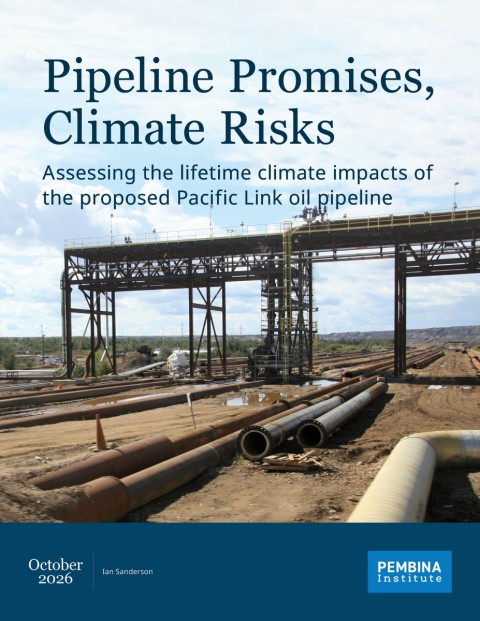
The proposed Pacific Link pipeline, formerly known as the West Coast Oil Pipeline, is being
advanced as a major export project that could carry up to one million barrels of bitumen per day
from Alberta’s oilsands to the west coast. This project was recently designated a Project of
National Interest by the federal Major Projects Office, despite the requirement that projects
receiving this designation contribute to clean growth and Canada’s climate objectives.
To date, little has been made of the impact this project would have on Canada’s greenhouse gas
emissions. This report assesses greenhouse gas emissions from Pacific Link construction and
operations, associated marine transport and the upstream production required to fill the
pipeline and compares it to estimates in the official submission by the Government of Alberta to
the Major Projects Office. It also compares four upstream scenarios, estimates lifetime
emissions over a 30-year operating period, and applies the Government of Canada’s social cost
of carbon. The analysis finds:
- Upstream production dominates the project’s climate impact. Filling the
Pacific Link with one million barrels per day of additional oilsands production would
generate approximately 24.81–28.75 Mt CO2e of upstream emissions each year. Pipeline
operations and marine transport would generate 0.8 Mt CO2e annually, while
construction would generate an estimated 1.4–1.5 Mt CO2e. These increases would offset
10% of the emissions reductions Canada needs to hit its 2035 emissions reduction target
of 45–50% below 2005 levels. - The Government of Alberta’s Major Projects Office submission likely
understates upstream emissions. Its estimate of 15.6–18.2 Mt CO2e per year relies
on emissions intensity declining at a rate approximately four times faster than historical
trends. The analysis also relies in part on potential global displacement benefits, which
are highly uncertain, difficult to measure, and not included in Canada's domestic
emissions accounting and climate targets. - If built, Pathways reductions do not offset pipeline-enabled growth. Annual
oilsands emissions rise significantly after the Pacific Link is built even when the
Pathways emissions reduction project, as laid out in the Alberta-federal MOU, is fully
implemented. By 2050, emissions are 50–66 Mt CO2e higher than under a Pre-MOUs
scenario, which assumes no new pipeline and stronger, earlier emissions reductions. - The Pacific Link pipeline would lock in significant lifetime emissions and
costs. Over a 30-year operating life, the project is estimated to add 676–900 Mt CO2e,
almost entirely from upstream production. The Pathways project would only offset 18% to 53%, depending on the future scale of the project. Combined, these projects stand to cost over $65 billion predominantly funded with taxpayer dollars. - The resulting climate damages are economically material. Applying the
Government of Canada’s social cost of carbon, the Pacific Link’s lifetime emissions
represent an estimated $219–253 billion in climate damages. These costs are not
reflected in the GDP, employment and government-revenue benefits emphasized by
project proponents.
Based on the evidence presented in this report, the Pacific Link as currently proposed will
increase Canada’s emissions by upwards of 738 Mt CO2e over the life of the project, more than
Canada emitted in 2024. This would exceed the emissions reductions Canada has pledged to
make as part of its 2035 and 2050 climate commitments. These risks must be considered as the
project moves through the regulatory process