
VANCOUVER — The taxpayer-funded Pacific Link pipeline project will drive new greenhouse gas emissions which would nearly negate progress from Alberta’s coal phase-out and cause substantial climate damages for Canadians, according to a new report from the Pembina Institute.
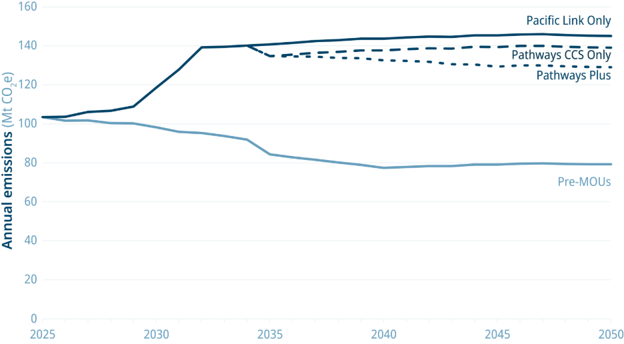
Pipeline Promises, Climate Risks finds that the emissions impacts of the Pacific Link project are dominated by increased oilsands production to fill the one million barrel/day pipeline. This additional production will release 24.81-28.75 megatonnes of carbon dioxide equivalent (Mt CO2e) each year.
Using the Government of Canada’s model to estimate the costs created by additional carbon emissions, Pacific Link would create $219-$253 billion in climate damages over its operational life, described in the model as “a variety of climate change impacts, including, but not limited to, changes in net agricultural productivity, human health effects, property damage from increased flood risk, disruption of energy systems, and the value of ecosystem services”.
In its submission to the Major Projects Office, the Government of Alberta estimated an increase of 15.6-18.2 MtCO2e per year, which relies on the assumption that industry will cut its emissions intensity four times faster than it has done in the past—an assumption that is even more unlikely due to the persistent under-performance of the TIER industrial carbon pricing system, which is meant to prompt investment in decarbonization. The submission also argues that Pacific Link will displace higher-carbon—but lower-cost—crude but does not provide evidence to support these assumptions.
“It should come as no surprise that adding a million barrels a day of very high-carbon intensity oil from Alberta’s oil sands, while significantly scaling back the Oil Sands Alliance Pathways project, results in a large net increase in greenhouse gas emissions,” said senior analyst Ian Sanderson. “This is like turning Alberta’s coal electricity fleet back on, only two years after Alberta successfully achieved the goal of replacing all that generation with renewable and gas power.”
“Pacific Link would lock in significant lifetime emissions and costs,” Sanderson said. “Over a 30-year operating life, the project is estimated to add 676-900 Mt CO2e, almost entirely from upstream production. The Pathways project—now much smaller than originally announced—would only offset 18-53% of these additional emissions. Combined, these projects stand to cost over $65 billion, predominantly funded with taxpayer dollars.”
Even leaving aside the downside economic risks, the benefits of the Pacific Link project are uncertain. The project’s high capital costs, high shipping costs, and the likelihood of weakening global oil demand are explored in detail in the Pembina Institute’s recent report, A Pipeline in Search of a Market.
"As Canadian leaders participate in the COP31 gathering in Antalya this week,” Sanderson said, “they should expect to be asked how the $50 billion announced for electrification in Budget 2026 offsets the new carbon emissions committed with the construction of the Pacific Link pipeline. Canada cannot meet its international commitments without answering that.”
Ottawa’s recent commitment of $50 billion towards various aspects of electrification in Canada including transmission lines, electric vehicle charging networks, and support for remote communities transitioning from diesel to renewable generation will translate into emission reductions. However, while it is simple to identify how public funding of high-emitting oilsands expansion will lead to increased emissions, until specific projects and policy mechanisms are identified, it is difficult to estimate the impact of this investment in electrification on Canada’s climate trajectory.
-30-
Quick facts
- Greenhouse gas emissions from oil sands production have increased every year and are now 177.3 per cent higher than 2005 levels, even while emissions from natural gas production have fallen by 31.1 per cent and from conventional oil production by 36.7 per cent over the same period.
- In 2021, oil sands corporations announced the Pathways project and said it would capture 68 Mt CO₂ annually by 2041, but their current proposal is to capture only 16 Mt CO₂ annually by 2045. A formal agreement between the oil sands corporations and the federal and Alberta governments is expected by November 15.
- A median-sized Canadian coal-fired power station emitted 1.46 Mt CO₂e per year before the national coal phase-out initiated by the Stephen Harper government. Coal was the main fuel for electricity generation in Alberta but the last coal-fired generator in the province converted to natural gas in 2024.
- Canada has committed to phasing out all coal-fired generation by 2030.
Visit the Pembina Institute’s website to download a copy of Pipeline Promises, Climate Risks.
Contact
Benjamin Alldritt
Senior Communication Lead, Oil & Gas
587-328-1955
Background
Report: A Pipeline in Search of a Market
Blog: Fuelling Canada’s oil and gas emissions