
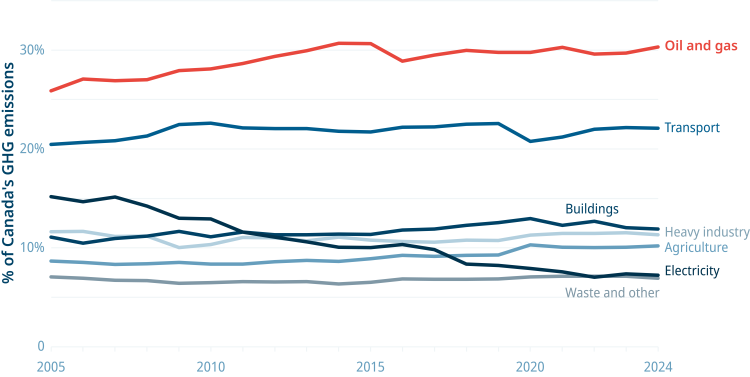
The oil and gas sector has been, and continues to be, the largest source of emissions in Canada (Figure 1) mainly due to oilsands growth. Despite this, and amid global actions to reduce reliance on fossil fuels, the governments of Canada and Alberta intend to increase oilsands exports and have weakened climate policies. If these actions move ahead, they will result in an increase in emissions and place an additional burden to reduce emissions onto other areas of the economy.
For the past decade, the governments of Alberta and Canada have been developing policies that would enable oil and gas growth while looking to constrain or even reduce net emissions. In the past few months, the governments have rolled back many of these climate policies. Further, they're now investing taxpayer dollars into risky infrastructure projects that lack a strong market outlook and will compromise Canada's ability to reach net zero by 2050.
In 2024, the oil and gas sector accounted for 30% of national greenhouse gas emissions. Compared to 2005, oil and gas emissions have also increased by 10 Mt CO2eq, the largest of any economic sector in Canada, and roughly equivalent to taking 3.3 million cars off the road for a year.
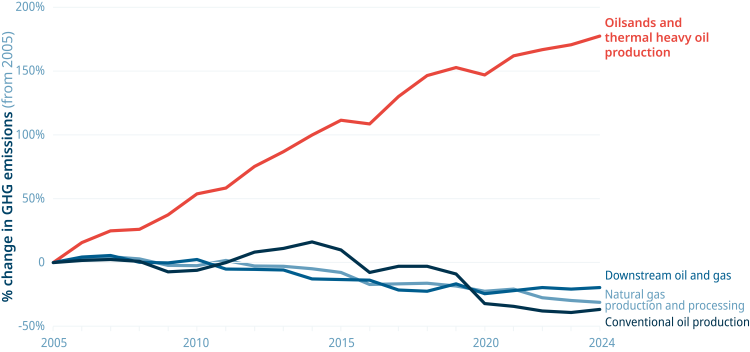
Oilsands production is the largest contributor to oil and gas emissions in Canada. In 2024, they accounted for ~47% of sectoral emissions — a proportion which has steadily risen since 2005. And while other subsectors like downstream oil and gas, conventional oil production, and natural gas production and processing have all reduced emissions, the oilsands have increased to a point which outweighs the emissions reductions of others (Figure 2). Oilsands production — in particular, in situ extraction techniques — requires significant heat which is mainly generated through natural gas combustion, resulting in an emissions-intensive product.
On the other hand, conventional oil and natural gas production primarily generates methane emissions, which have been reduced through effective methane regulation (particularly in British Columbia). This becomes clear when comparing each subsector’s change in emissions from 2005:
- Oilsands: +177.3 %
- Downstream oil and gas: −19.5%
- Natural gas production & processing: −31.1%
- Conventional oil production: −36.7%
Oilsands production has also steadily increased over time, growing by 47.9 million m3 compared to conventional oil increasing by 6.66 million m3 between 2017 and 2025. Given these trends, we can expect that production and emissions will increase even further with oilsands expansions coming to fruition.
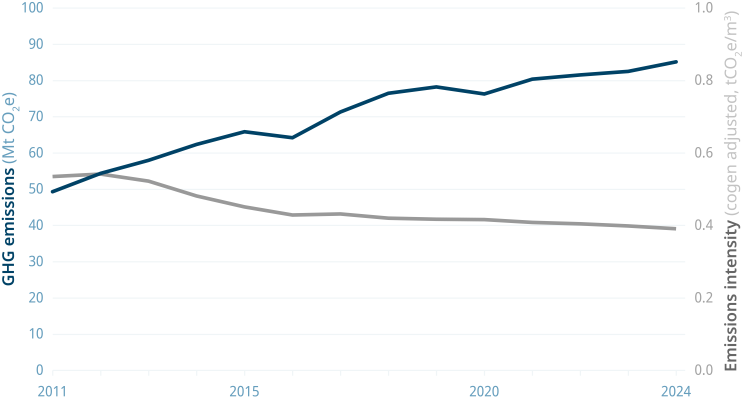
Despite claims that oilsands emissions have decreased over recent years, subsector emissions data tells a much different story (Figure 3). The oilsands made progress in reducing their emissions intensity in the early 2010s, but further progress has largely stalled and expansion has overwhelmed intensity gain in the past decade, resulting in a 72% increase in annual emissions since 2011. And although the recent Memorandum of Understanding between the governments of Alberta and Canada (where the Pathways Alliance carbon capture and storage project is accompanied by a new pipeline) is meant to reduce emissions alongside oilsands expansion, our analysis indicates this would result in even greater emissions.
The Northern Shield and West Coast pipelines have been presented under the guise of nation-building and improving energy security; however, Canadians should be aware of the many associated risks. Economically speaking, oil and gas products will still be vulnerable to volatile market prices, and the appetite for oil in key markets like China and the EU is slowing as electric vehicles surge. From a climate and health perspective, continued emissions contribute to the increased frequency and severity of extreme weather events Canadians have become all too familiar with in recent years, including heatwaves, flooding and wildfires.
If industry proponents think these pipelines are viable, they should be the ones investing to see them move ahead instead of taxpayers. The tens of billions of public funds could instead be used to decarbonize and shift towards cleaner, cheaper electrification where possible. This can achieve even greater energy security and improve long-term affordability for Canadians, while putting us back on track to meet our climate targets.