
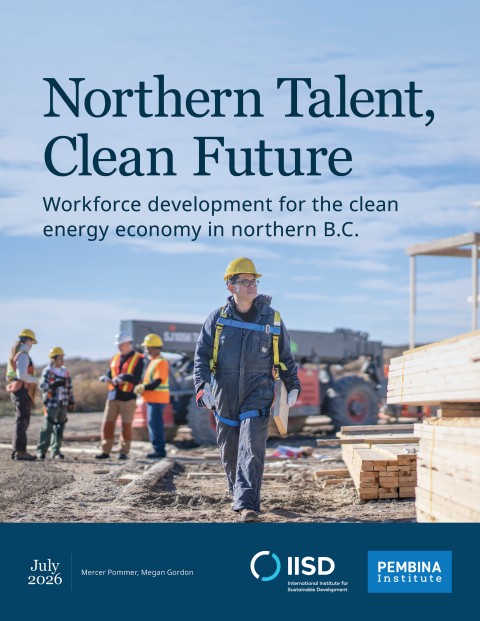
Northern British Columbia is entering a period of economic transition, with new opportunities emerging in clean energy, critical minerals, transportation, mass timber and other low-carbon industries. This report finds that while workforce development systems are struggling to keep pace with changing labour market needs, strengthening training capacity, fostering stronger partnerships, and improving regional workforce planning can help communities and workers benefit from the region's growing clean economy.
Key messages
- Northern B.C., which has historically relied on resource industries, is experiencing uneven but more diverse growth.
- The area already has strong foundations for workforce development, including post-secondary institutions, Indigenous-led initiatives and employer partnerships.
- Workforce shortages, limited training capacity and barriers to education are constraining economic opportunities.
- A resilient Indigenous workforce depends on community-led planning that integrates housing, infrastructure and education with local culture and priorities.
- Current government strategies do not adequately connect workforce development to future industry needs.
- Coordinated action and sustained investment can help build a stronger, more resilient workforce for northern B.C.’s clean energy future.
Why is workforce development critical in northern B.C.?
Northern B.C.’s economy is changing. While forestry, mining, and oil and gas remain important industries, growth in clean energy, critical minerals, transportation and mass timber is creating new workforce needs. The area spans four economic regions — the North Coast, Nechako, Cariboo and Northeast — each with distinct market conditions and opportunities, highlighting the need for workforce planning that reflects local realities.
What workforce challenges are restricting clean economy growth?
- A small and dispersed population makes it harder for employers to find workers with the skills needed for emerging industries.
- Training is difficult to access due to long travel distances, limited transportation services, limited housing for students and unreliable internet access.
- Post-secondary institutions face funding and capacity constraints that limit their ability to expand programs, deliver mobile training and respond quickly to changing industry needs.
- Indigenous communities continue to experience systemic barriers to education, training and employment.
What policy gaps are limiting workforce development?
- Funding for post-secondary institutions and workforce programs is not sufficient to meet growing and shifting skills demand across the region.
- Successful workforce programs that addressed northern community needs have not been consistently scaled or sustained.
- Employer-led training is underutilized as a tool to build skills, reduce training costs and create work-integrated learning opportunities.
- Provincial economic and climate strategies often lack region-specific workforce plans.
- Provincial economic development priorities emphasize major resource projects, but do not sufficiently support long-term workforce development and economic diversification.
- Despite targeted supports, gaps remain in Indigenous education and training systems, including challenges recruiting high-quality staff.
Report recommendations
The report emphasizes that northern B.C. already has important foundations in place; however, it recommends action in three areas to overcome existing challenges.
Strengthen training capacity
- Increase funding for northern post-secondary institutions and training providers.
- Expand community-based, mobile and flexible training options.
Build stronger partnerships
- Improve collaboration among governments, Indigenous communities, employers, unions and training providers.
- Expand work-integrated learning opportunities for secondary students.
Support long-term economic resilience
- Integrate regional workforce planning into climate and economic strategies.
- Encourage economic diversification alongside major projects.
Northern B.C. is well positioned to benefit from the growing clean energy economy. With coordinated planning and sustained investment from governments, Indigenous communities, employers and training providers, the area can build a skilled local workforce ready to lead that transition.