

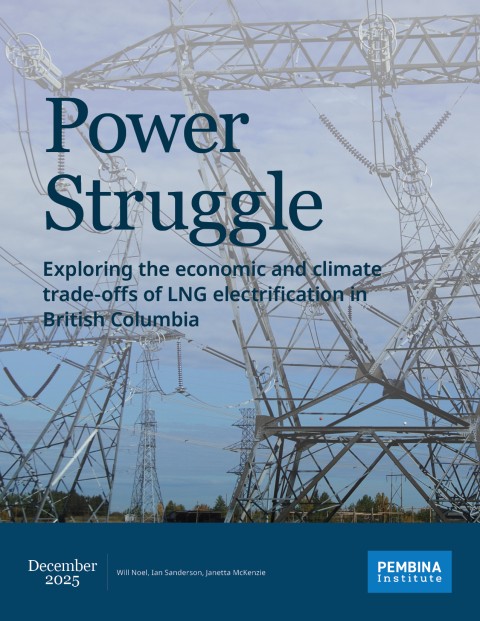
British Columbia is entering a pivotal moment in its energy transition. Having recently announced a second round of clean power procurements, the province must now decide how to allocate its growing supply of renewable electricity to its growing economy. This report explores the trade-offs of prioritizing the electrification of liquefied natural gas (LNG) terminals — and the associated upstream extraction activities — relative to emerging opportunities such as critical minerals, battery manufacturing, data centres and port electrification. Our analysis highlights several benefits of diversification from legacy sectors as Canada seeks to improve its economic resilience in this era of nation building. We find that:
- The benefits of diversification are significant, generating more than double the GDP and creating more than triple the jobs relative to investing exclusively in LNG expansion, as explored in our Mixed Growth and New Foundations scenarios.
- The economic benefits of LNG development are most substantial during construction. Once LNG facilities start to operate, financial benefits shift from local economies to global markets through companies and shareholders. In contrast, diversified investment across emerging and energy-transition aligned industries deliver strong, sustained economic benefits throughout their lifetime. Critical mineral mines require significant amounts of labour while producing raw materials. Downstream manufacturing uses these materials to produce high-value, exportable goods, generating skilled jobs and consistently boosting local economies.
- During construction, battery manufacturing plants and data centres still outcompete most LNG terminals in both GDP and jobs per unit of electricity allocated, with significantly shorter construction timelines and higher value-added outputs.
Our results strongly suggest that over-investment in LNG development risks crowding out high-growth clean industries while locking B.C. into a sector with uncertain long-term viability. LNG projects still need to be accountable for their emissions — but as provincial and federal governments are deciding where to allocate public dollars for the most impact, our analysis finds that prioritizing LNG over other sectors does not lead to the best results for B.C.
Clean electricity is a valuable resource that is in high demand. Strategic allocation toward sectors with long-term growth potential, aligning with global investment trends, will ensure both economic and environmental benefits. It is imperative that B.C. consider the full opportunity cost of LNG expansion when evaluating future investments.