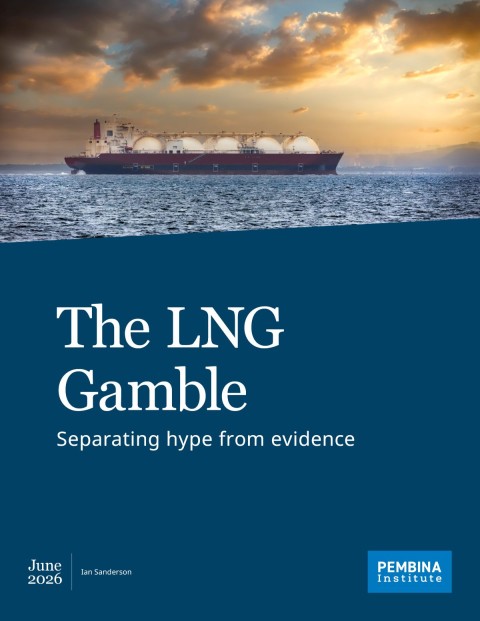
Global liquefied natural gas markets have been upended by the conflict in Iran and the disruption of key Middle East supply routes. The resulting price spike and volatility illustrate how quickly LNG can become unaffordable for many importing countries and how rapidly demand can be destroyed in price-sensitive markets. While these shocks can tighten markets in the near term, they are also likely to accelerate longer-term energy security strategies that reduce reliance on imported fossil fuels — including faster deployment of renewables, storage, grid modernization, and, in some countries, nuclear. This report focuses on these long-term structural factors that are likely to determine whether new Canadian LNG projects are viable by assessing the economic, market, and climate risks associated with large-scale LNG expansion in Canada at a time of profound structural change in global gas markets.
LNG demand growth is slowing or stagnant
Across key prospective Asian markets, LNG demand growth is slowing, uncertain, or highly price-sensitive. In China, LNG imports are constrained by rising domestic production, expanding pipeline imports, and a limited role for gas in power generation alongside rapid renewable and nuclear build-out. In Japan and South Korea, LNG use is flat or declining as nuclear and renewables expand, and Japanese firms increasingly act as LNG portfolio traders rather than long-term end-market anchors. In India and other emerging economies, LNG demand responds sharply to price and typically grows meaningfully only when global prices fall to levels that are difficult to reconcile with the economics of new, higher-cost supply.
Canadian LNG faces a challenging global market
At the same time, the industry is entering a historic supply wave led by lower-cost producers, particularly the United States and Qatar, raising the risk that short-term market tightness gives way to renewed oversupply once the conflict is resolved. Market fundamentals are also shifting away from rigid, long-term take-or-pay contracting toward shorter-term, hub-linked pricing, increasing exposure to price volatility and weakening the revenue certainty that traditionally underpins LNG project financing. In a more competitive and flexible market, higher-cost new entrants are likely to be displaced first when margins compress.
Canadian LNG projects are particularly exposed in this environment because they sit higher on the global cost curve. High capital intensity, long supply chains, and major associated infrastructure increase breakeven costs and narrow the buffer against cost overruns, delays, or sustained periods of lower prices.
Coal replacement may not happen
The price levels required for large-scale coal-to-gas switching in emerging Asian power systems are below the long-run breakeven costs of new Canadian projects. In practice, LNG increasingly competes with rapidly scaling renewables and storage rather than displacing coal, making climate benefits uncertain while leaving projects exposed to both demand risk and carbon-related competitiveness risk over time.
Recommendation: Private capital should handle the risk
Despite these risks, Canadian LNG projects have received significant taxpayer subsidies through direct financial support, publicly financed infrastructure, preferential electricity rates, and foregone tax revenue. This shifts material market risk from private proponents to taxpayers and increases the likelihood that public funds will be exposed to stranded asset outcomes if global demand and prices evolve unfavourably. It also risks prioritizing LNG’s use of clean electricity over other sectors that could deliver greater and more durable economic and climate benefits. Overall, Canadian LNG may present an export opportunity for private firms, but it does not represent a good bet for further taxpayer subsidies. Governments should not use public dollars to de-risk private LNG projects; proponents should proceed only where projects can attract private capital on their own merits and withstand realistic price, demand, and climate policy conditions.