CALGARY — Canada can maintain economic growth and continue oil and gas production while reaching a 2050 net zero goal by introducing stronger climate policies, according to the Pembina Institute’s analysis of new modelling from the Canada Energy Regulator (CER).
“Aligning emissions reductions with long term economic growth does not require sacrificing prosperity,” said Ian Sanderson, senior analyst at the Pembina Institute, “but it does require strengthening climate policy in ways that align the Canadian economy with the ongoing global energy transition.”
The Canada’s Energy Future 2026 report, recently released by the CER, includes various scenarios – not forecasts – to explore what Canada’s emissions and economic outcomes could look like under various conditions. The regulator modelled three scenarios of emissions outcomes given Canada’s current policies and varying global economic conditions, and a fourth scenario of economic outcomes if Canada introduced new policies that cut emissions to net-zero by 2050.
In all three of the CER’s current policy scenarios, Canada’s emissions are nowhere near the downward trajectory needed to reach net zero by 2050. To achieve those reductions, Canada would need to make significant policy changes to reduce emissions, including from oil and gas, Canada’s highest-emitting sector. .
In that scenario, in which Canada successfully cuts emissions to net-zero by 2050, the CER model dramatically challenges the popular idea that this success comes at the expense of economic growth and fossil fuel production.
“A persistent argument against ambitious climate policy is that emissions reductions come at the cost of economic prosperity,” writes Sanderson in his Rethinking Canada’s Energy Future analysis. “The CER's own modelling does not support this. Across scenarios, including Canada Net-Zero, GDP follows a broadly similar upward trajectory to 2050. The Canadian economy does not shrink under net-zero; it grows, at a pace comparable to current measures even in a low oil and gas price environment."
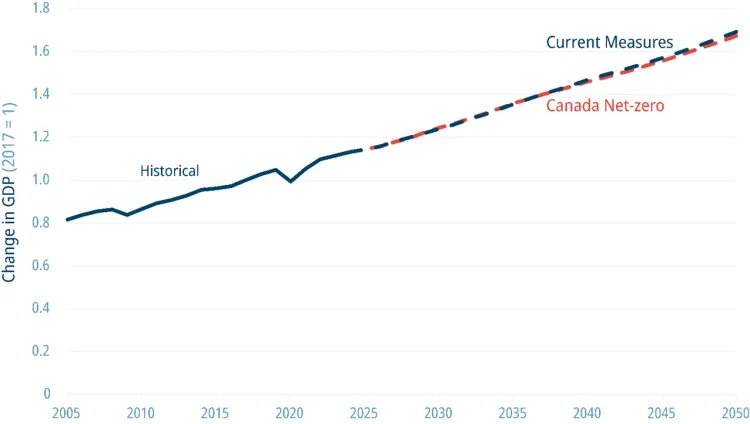
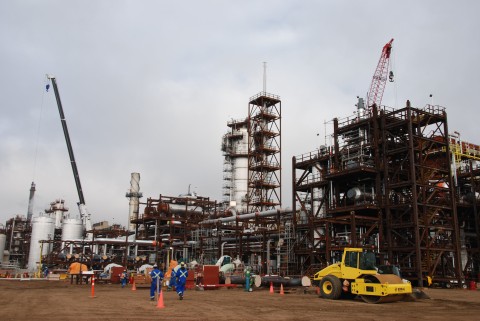
In the net-zero scenario, oil and gas production continues to rise into the mid 2030s, before returning to levels comparable to current production by 2050. These production levels track a similar path to forecasts of global oil demand published by Shell, BP, and others. To bring oil and gas emissions down to this extent, Canada would need an industrial carbon price sufficient to drive investments in carbon capture at scale.
Two critical early steps would be fixing Alberta’s broken industrial carbon pricing system, known as TIER, and constructing the Pathways carbon capture project, which was proposed by industry in 2022. Both issues are central in the ongoing climate talks between Alberta and the federal government.
“The CER’s results clearly illustrate the need for Canada’s industrial carbon pricing systems to work effectively - and that means the government of Alberta’s ongoing negotiations with the federal government will have a seismic impact on Canada’s ability to keep pace with the global energy transition.”
Quick facts
- The Canada Energy Regulator has published regular editions of its Canada’s Energy Future report since 2007.
- The future of industrial carbon pricing and large-scale carbon capture technology are central questions in the climate and energy talks between Alberta and Ottawa.
- Alberta’s oilsands emissions have risen every year and are forecast to continue to rise without meaningful regulation.
[30]
Contact
Senior Communications Lead, Oil & Gas, Pembina Institute
587-328-1955