
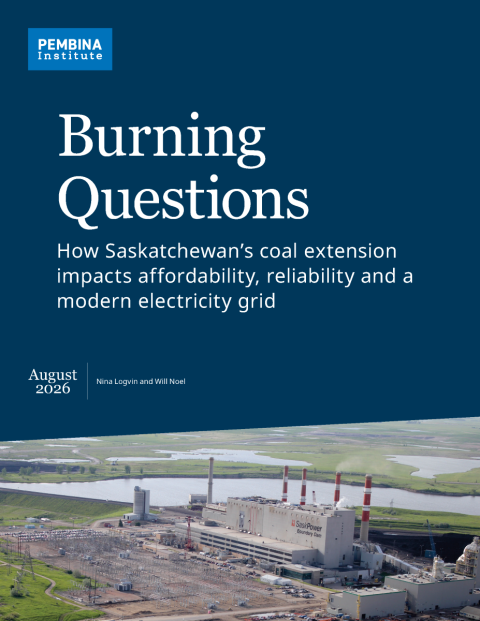
Saskatchewan, much like the rest of Canada, is confronting important questions about how it will expand and strengthen its electricity system. With some of the best wind and solar resources in Canada, the province is uniquely positioned to meet this task without compromising on affordability, reliability, and resilience.
In recent years, Saskatchewan and its crown utility, SaskPower, have taken positive steps to take advantage of these resources and diversify their supply mix. These efforts have led to an impressive reduction in their electricity emissions intensity by 35% in the past 15 years, representing a meaningful progress on building an affordable, modern energy system. In June 2025, the provincial government reversed course, announcing it would refurbish its aging coal-fired generation fleet, keeping them running for an additional 20 years until 2050, and reverse its plans to achieve significant renewable capacity by 2030.
This report examines the affordability, reliability and emissions implications of these decisions.
Our findings
- Coal is Saskatchewan's most expensive electricity option: Our analysis estimates extending coal would cost $26-32 billion, compared to $18-25 billion for natural gas and $12-17 billion for renewables, plus about $1 billion for battery storage.
- Saskatchewan residents will pay the price: Already facing some of Canada's highest electricity rates, customers could see rates double by 2040 under the province's coal-extension plan, according to internal SaskPower documents.
- Renewables can deliver reliable power: Jurisdictions such as Texas, California, and Denmark have strengthened grid reliability using energy storage, transmission links, and demand-response programs. Saskatchewan can achieve similar results while reducing costs and phasing out coal.
- Saskatchewan is now Canada's last coal-dependent province: Alberta, Ontario, and Manitoba have already eliminated coal generation, while Nova Scotia and New Brunswick are on track to phase out coal by 2030.
- Extending coal increases regulatory and financial risks: The province's plan conflicts with multiple federal emissions and equivalency frameworks, creating potential legal, regulatory, and investment risks.
- The decision has national consequences: Delaying coal phase-out by 20 years would increase Canada's electricity-sector emissions by 15% compared to a 2030 phase-out, equivalent to adding the annual emissions of a mid-sized country such as the Netherlands.
Our recommendations:
Saskatchewan’s electricity system is standing at a crossroads as electricity demand rises. With its decision to recommit to coal-fired generation for the next 20 years, the province is locking itself into one of the most expensive and outdated electricity options it has at its disposal. This is a decision that will have a significant impact on Saskatchewan residents, businesses, and the country at large.
In contrast, every other Canadian province has shown that the transition off coal and toward cleaner and lower-cost alternatives is not only feasible, but is also increasingly the norm — especially now, as technologies like wind, solar, and storage become cheaper, faster, and ever more compelling to build. Saskatchewan has an opportunity to follow the same path by building a more diverse and flexible electricity grid that can meet future demand while avoiding unnecessary costs and risks.
To support that outcome, we propose three recommendations for both the province and the federal governments:
- Get Saskatchewan’s electricity transition back on the lowest-cost track. Saskatchewan should return to the lowest-cost pathway it was following prior to delaying its coal-phase out and recommit to ending conventional coal-fired generation by 2030. To achieve this, Saskatchewan should prioritize a diversified portfolio of generation technologies and complementary resources that can meet future demand reliably while keeping electricity rates affordable.
- Put reliability, affordability, and emissions at the centre of SaskPower planning. The province should require SaskPower to model future supply scenarios based on meeting decarbonization and reliability objectives at the lowest cost to ratepayers. This planning should be transparent and resume community and stakeholder engagement consistent with SaskPower’s 2024 sessions.
- Protect the integrity of Canada’s coal-phase out in federal-provincial equivalency deals. The federal government should only pursue an equivalency agreement with Saskatchewan if it contains a clear pathway for phasing out coal generation in the short term, while safeguarding national emissions reduction targets and international leadership on phasing out the dirtiest fuel.