After years of letting its methane regulation fall further and further behind modern best practices, the Alberta government appeared to have a breakthrough in late March.
But slightly later in March, we had to push the corks back into the champagne bottles.
What happened?
On March 25, Alberta Premier Danielle Smith and Prime Minister Mark Carney announced their governments had reached an agreement-in-principle. The deal committed both sides to “an outcome-based equivalency agreement under the Canadian Environmental Protection Act.” That should bring Alberta’s methane emissions down by the same amount as strong new federal rules announced in December 2025 after three years of consultation.
Crucially, the two governments also agreed to jointly select a third party “to conduct methane modelling, analysis of emissions reductions, and to assess methane reduction results.” This is a major development because the Alberta government’s methane inventory, which uses estimates self-reported by the oil and gas industry, indicated only about half of the methane emissions published in the national inventory report, which incorporates actual measurement of emissions using sensors.
Only 48 hours later, on March 27, Alberta published a new edition of its methane regulations.
It’s hard to reconcile how a government could sign a deal committing itself to equivalent outcomes and then immediately publish regulations that so obviously — pointedly — cannot deliver equivalent outcomes.
Provincial governments can and do apply to opt out of federal regulations if they can prove that their own regulations will deliver the same results on the same timeline, albeit using different methods.
The federal government determines whether the provincial regulations would result in equal outcomes and if they do, the governments sign an equivalency agreement that stands down the federal rules in that province for the life of the agreement. If an agreement can’t be reached, then the federal regulations remain in force.
This process has worked successfully many times, including BC’s 2020 equivalency agreement on methane, which led to that province reaching its 2025 methane targets ahead of schedule, even while industry ramped up gas production.
But in Alberta’s case, we’re not just talking about squaring away a few details. How far apart are the federal methane regulations, and their new counterparts in Alberta? Let’s compare:
| Federal methane regulation | Alberta methane regulation | Comparable outcome? |
| Prohibits routine venting from all new and existing sources (including pneumatics, tanks, dehydrators, compressors) by 2030 | No prohibition on routine venting from any existing sources, or from new sources other than dehydrators | No |
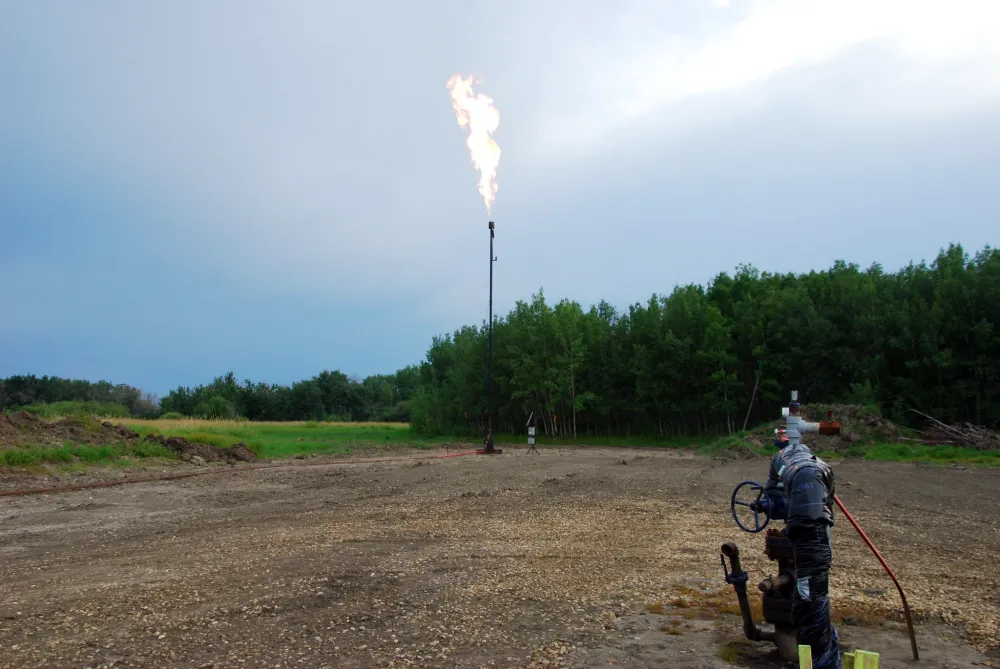
| Prohibits routine flaring except where an engineering study shows using the gas on-site is infeasible | No prohibition on routine flaring; introduces measures to ensure flares remain lit | No |
| Increases frequency of leak detection and repair surveys to 4x/year at high-risk sites | Maintains frequency of leak detection and repair surveys at 3x/year at high-risk sites | No |
| Monthly instrumented leak screening required if operator is on site | Annual leak screening required unless a leak detection survey has already been conducted; need not be instrumented | No |
| Annual third-party inspection requirement | No third-party inspection requirement | No |
Just for clarity, there are no other areas in which Alberta is trying to find emissions reductions to make up for these obvious shortcomings.
There’s a lot at stake here, both for Canadian climate policy and for the actual climate. Equivalency is a legal principle upon which numerous good faith agreements have been built and signed. Fudging equivalency with Alberta risks undermining those existing agreements. The Carney government is already testing the limits of equivalency by giving Alberta industry five more years than the rest of Canadian industry to cut their emissions. Our analysis shows that (assuming emissions gradually decline until 2035) those extra five years for Alberta mean an additional 1.9 million tonnes of methane emissions, equivalent to 53 million tonnes of carbon dioxide, which is about a year’s worth of exhaust from 12 million cars.
A ten-year deal is a bad idea, but it could be redeemed by strong and front-loaded emission reductions. Alberta’s regulations don’t achieve this; they are patently weaker than the federal government’s in every respect.
We have seen this behaviour before. In November 2025, Smith and Carney signed a memorandum of understanding to resolve their differences on climate and energy policy. Methane was one of the items in that memo. But perhaps the most consequential item was an apparent agreement to ramp up the price of Alberta’s badly undervalued carbon credits. Ten days later, the Alberta government implemented changes to regulations that further undermined industrial carbon pricing. A voluntary deadline of April to reach that agreement on carbon pricing has come and gone with no deal announced.
Putting politics aside, the federal government does have the law on its side. If Alberta refuses to bring a real proposal to the table, then the federal regulation stands. But the best outcome would be for Canada’s major oil-and-gas-producing province to catch up with BC and renew progress on methane emission reduction. It’s the most low-cost, high-impact way to slow the effects of climate change and to secure international markets for Canadian energy products.
Try again, Alberta.