
We all ❤️ interties.
That’s the current mood in Canada where a recent national energy corridor agreement on new electricity transmission projects sparked glowing remarks from energy ministers in two territories and eight provinces, including Alberta.
Alberta’s Affordability and Utilities Minister Nathan Neudorf is one of the most vocal supporters of increasing the use of these high-voltage wires, which boost the reliability of electricity supplies and increase provinces’ ability to share more of their lowest-cost electricity with each other. Interties allow for the import and export of electricity by connecting two or more regional power grids.
Expanding existing interties and building more of them help prepare us for a future where more of our everyday energy uses, from home heating to transportation to heavy industry, will be powered by abundant, low-cost electricity.
In an interview with the Hub on March 10, Neudorf discussed several forward-thinking intertie ambitions and options, as follows:
- “While we have three (interties), we are still considered an island in terms of electrification,” he said. “If we can add two more, or strengthen the ones we have to a larger size, we think that it can be a win-win situation.”
- Compared with other grids in Canada, the amount of electricity Alberta can currently import through its existing interties is relatively low — currently less than five per cent of its installed electricity capacity. Building up its existing wires (with B.C., Saskatchewan and Montana) would allow Alberta to both export surplus electricity (which other provinces would pay for) and also draw in more power from its neighbours when needed.
- Other jurisdictions know the value of strong interconnections and have set targets. The European Union, for example, has set an electricity interconnection target of 15 per cent by 2030, meaning that each country should have the infrastructure needed to import the equivalent of at least 15 per cent of the electricity capacity in its territory. Compared to the EU benchmark, Alberta is currently sitting at around three per cent interconnectivity with a current total installed capacity of 23,300 MW and effective import capability of about 650 MW from B.C., Saskatchewan and Montana.
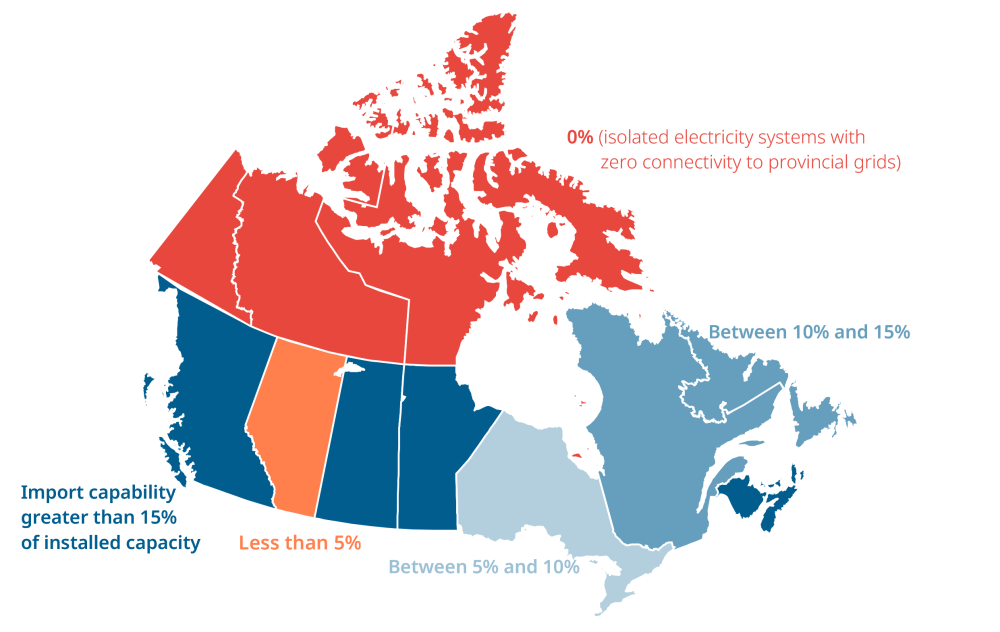
Import capability in percentage of installed capacity for provinces and territories in Canada
- Restoring the Alberta-B.C.-Montana intertie to full capacity, plus investing in another new intertie to B.C., would put Alberta in the realm of 10 per cent interconnectivity, much closer to the EU benchmark.
Intertie limitations linked to worst case scenario preparedness
Electricity system operators always need to plan for what is called the Most Significant Single Contingency (MSSC). That is to say, if this generator were to drop off-line, the system needs to have something on standby of that same magnitude. The Alberta Electric System Operator (AESO) treats the B.C. and Montana interties combined as the MSSC, so AESO has to pay for something on standby that totals whatever those interties are allowed to be. AESO has only procured about 500 MW of contingency, so combined, B.C. and Montana are told they can never import more than 500 MW combined. There is no physical problem with the lines themselves — it has been an AESO economic choice to limit the ability to import. So, when "line restoration" is talked about, what it means is actually procuring standby capacity in the province to allow us to use the lines to their actual physical ability. The intertie is supposed to allow 950 megawatts of imports, but is currently at 40 to 60 per cent of that amount.
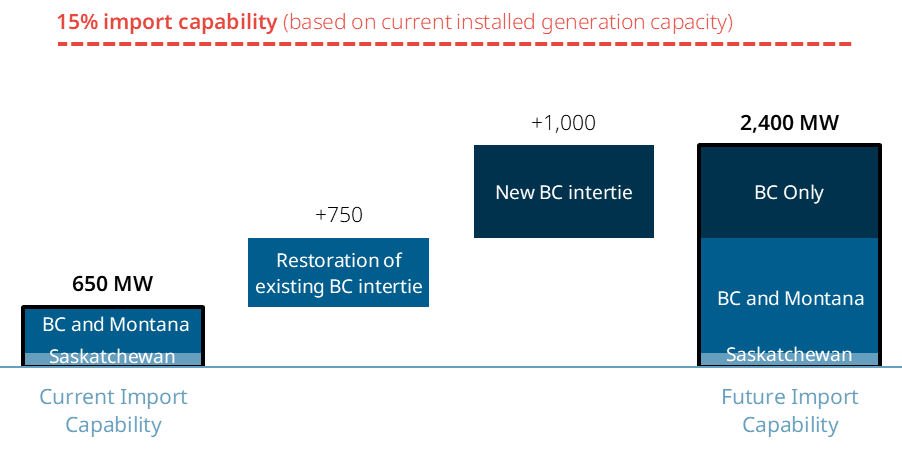
Alberta's current and potential future import capability based on Minister Neudorf's direction
- Canada, as a whole, has more electricity interconnection capacity with the U.S. (27 gigawatts) than connections between provinces and territories (17 GW). But the new national energy corridor agreement aims to change that.
2. Neudorf said Alberta would love to have another intertie with northern British Columbia. “It would help their economy. It would help our economy.”
- In fact, Alberta’s electricity system costs could fall $200 million per year if the existing intertie with B.C. and Montana is expanded to 1,500 megawatts (MW), with steadily increasing savings at higher levels of interconnection, according to a 2023 study. This cost-savings would be largely passed on to consumers, especially large industrial ones.
- There would also be an impact on the GDPs of both provinces. The same study estimated that restoring the current intertie would result in an $870 million increase in Alberta’s GDP, and a $183 million increase to B.C.’s. These increase to $1.2 billion and $574 million, respectively, if an additional, similarly sized intertie is added.
- Interties fuel economic growth by enhancing grid reliability, reducing electricity costs, enabling the expansion of renewable energy, and facilitating energy trade. Alberta could actually expand its exports of clean power if it had access to increased intertie capacity. By allowing regions to share power, interties function as economic "bridges" that optimize resources, attract investment and support industrial development.
3. “British Columbia has a lot of hydroelectricity,” Neudorf explained. “That dam and storage system is really a very long-lasting, very, very large battery.”
- Minister Neudorf has this right. Hydro can be used like a battery by storing up the water behind the dam when hydro power isn’t needed, then releasing the water when electricity demand spikes. That battery could supply power to Alberta when less solar or wind energy is available. Equally, an expanded intertie would also allow B.C. to use more of the excess solar and wind power that is frequently generated in Alberta during peak production times. It’s a win-win because both provinces get increased access to low-cost renewable power, all year round.
- B.C. has about 16,400 MW of hydroelectric capacity with a peak demand of about 11,360 MW. This means that under current conditions, B.C. is (effectively) a 5,000 MW battery that could, in theory, discharge for weeks to months, versus a typical lithium-ion battery of one to four hours. However, Alberta is only using up to 400 MW of this giant “battery” due to insufficient transmission infrastructure. Restoring the intertie, and building a new one, would change that.
4. That’s not where the ambition ends. Neudorf said stronger interties could also support electricity supply further north, helping power regional development and resource extraction. “If we could go to the Northwest Territories or, in combination with British Columbia, to the Yukon.”
- A stronger electricity supply to northern B.C., the Northwest Territories and the Yukon could help power regional development and critical mineral resource extraction. Significant economic opportunities can be found by electrifying critical mineral mining. According to our analysis, on a per-megawatt basis, electrification of these mines would have a GDP impact 2.5-to-14-times greater than LNG terminal electrification, and similar employment impacts to that of LNG terminals.
- Critical mineral mining powered by primarily clean electricity has an emissions intensity that is 68 per cent lower than the global average due to a reduced dependence on fossil fuels (primarily diesel and natural gas). There are already signs that low-carbon critical minerals have an advantage: companies with ambitious internal climate targets are tapping into a new category of sustainable finance products that offer more attractive terms for lower-carbon projects.
- Expanding those northern transmission connections would also reduce reliance on diesel generation in remote communities. For every terawatt-hour (1,000,000 megawatt hours) of diesel generation replaced by clean alternatives, we can avoid between 18 and 19 premature deaths caused by air pollution and up to 720 kilotonnes of carbon emissions. (One terawatt-hour is approximately the same as the monthly electricity usage of a city the size of Edmonton.)
5. Improving interties does come with a cost. Neudorf said a new intertie project could cost more than $2 billion and approach $3 billion, depending on the route and design.
- This aligns with our own estimates. Combined with the Alberta Electric System Operator’s estimated $150 million to restore the existing Alberta-B.C. line, and an additional $1.5-2.7 billion to procure 750 to 1,500 MW of batteries for frequency response, we’re looking at a total investment of $4.6-5.8 billion.
- But investment also means jobs. Using employment factors for batteries and transmission, this project could generate a total of 4,850 to 5,250 jobs during the five-year construction period. It would also offer a flow of lowest-cost electricity that would jump-start new industries and prosperity. Power-hungry consumers like data centres prefer low-cost clean energy and they want power now, not in 10 years. We’re already seeing some of that demand going to jurisdictions with clean energy. Bell Canada’s data centres in B.C. and Deep Sky’s $200-million carbon dioxide removal project in Manitoba were both projects announced last year with locations chosen due to access to clean power.
This is the right time for Alberta, and other provinces and territories, to be making forward-thinking choices that will expand the connections between grids, effectively making our electricity systems more resilient, efficient and lower cost. In the decades ahead, electricity demand across Canada is only going to grow: the latest Canada Energy Regulator projections put it in the range of 25 to 100 per cent demand growth by 2050.
And, like Neudorf, the Canada Energy Regulator sees interties playing an increasingly important role balancing variations in electricity supply and demand across provincial systems. By 2050, total interprovincial transmission capacity increases by roughly 70 per cent, with expansions along nearly all interprovincial corridors. If Neudorf’s plans come to fruition, Alberta will fit in well with that picture.