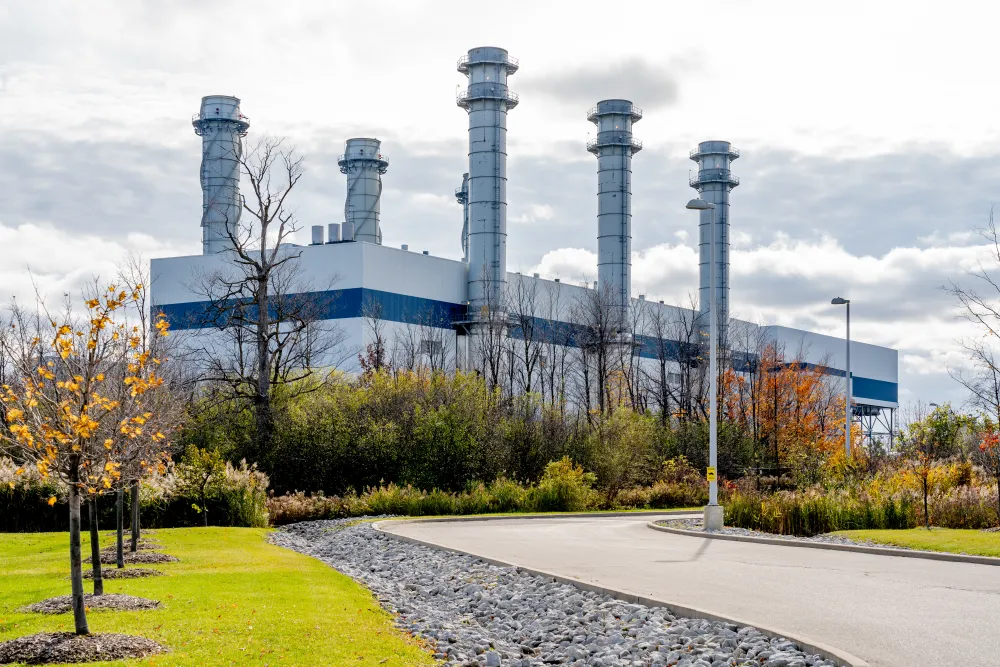
Ontario’s electricity consumers face heightened risks as the province plans to increase gas-fired power to compensate for nuclear plants shut down for multi-year refurbishments.
By 2030, gas generation in Ontario is slated to grow to five times its 2020 level to compensate for those shutdowns, according to modelling by the Independent Electricity System Operator (IESO). It’s also not expected to return to 2020 levels for another 15 years.
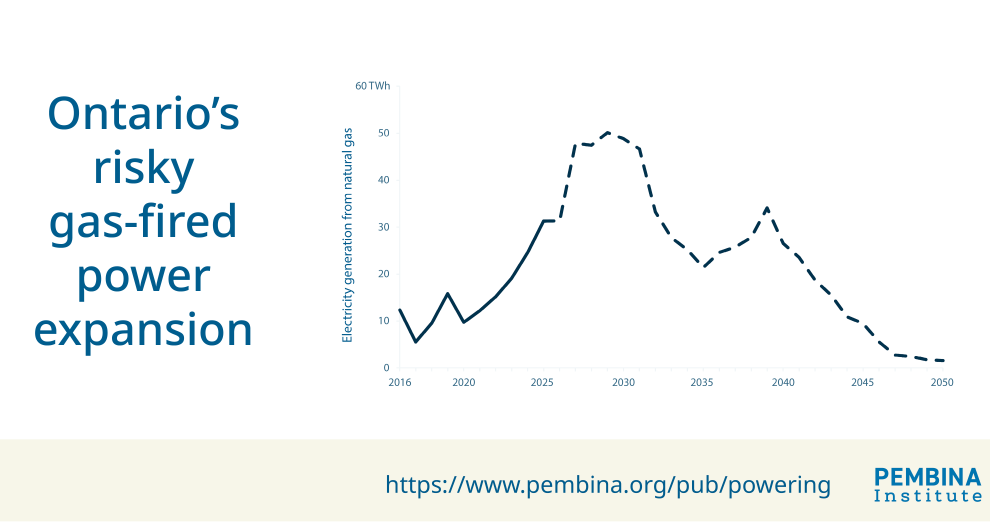
Increasing natural gas power carries several risks, as outlined in our recent report Powering ON: Examining Ontario’s Integrated Energy Plan. These include:
- Energy security risks
- Higher price volatility
- Higher carbon emissions
Each of these on their own should be flags that would warrant some serious consideration of other options, especially when so many people will face the consequences of the wrong decision.
The risks of choosing natural gas generation in Ontario
If the province continues to rely on more and more natural gas power, they’ll lock in:
- Energy security risks: Most of Ontario’s gas — 70 per cent — is currently supplied by the U.S. Given current trade tensions, we know how risky that reliance can be. Increasing this reliance when it comes to something as critical as electricity goes directly against Ontario and Canada’s goals to diversify trade relationships.
- Cost volatility: Gas prices are subject to commodity market swings, so our analysis shows that the more reliant a grid is on gas, the more volatile electricity prices are. Ontario recognizes that stable and affordable electricity is key for industry and household prosperity, and relying on gas power puts those goals at risk.
- Higher emissions: Ontario committed to reduce electricity emissions to nearly zero by 2050, and Canadian corporations are hungry for affordable, low-carbon energy. At a time when most electricity grids are getting increasingly cleaner, Ontario’s grid emissions are creeping up. In 2024, it was 84 per cent emissions free, down from a more impressive 96 per cent in 2017. Ontario’s increased use of gas power will cause its electricity emissions to triple between 2023 and 2030, from 6.3 to 19.1 megatonnes of carbon dioxide equivalent per year. This could make the province less competitive at attracting businesses seeking clean energy.
These risks are heightened over the coming decade as gas power increases in the system. The government intends to limit gas power to an “insurance policy” for reliability in the long term, but if their nuclear buildout plan is delayed (in line with global experience), the risks are prolonged.
More wind, solar and batteries can reduce the risks of increasing gas
Thankfully, there are alternatives that can reduce these risks. Mixing in more renewables — the most affordable forms of new generation that you can build right now — would result in less costly electricity. That’s because costs for Canadian renewable energy projects have been cut in half in the last 10 years. And renewables are only going to get cheaper.
Batteries, which also saw a 90 per cent cost reduction in the last 15 years, can be used to store energy from wind and solar for those times when the sun isn’t shining and the wind isn’t blowing. Ontario made good use of its Oneida battery facility during a heat wave that created a spike in demand in June 2025. Relying more on batteries for these peaks in demand can limit the need to turn to gas plants that are standing by for such times.
Renewables, once built, also reduce energy security risks. You don’t need to import sunshine or wind, nor can anyone impose a tariff on them year after year. Gas is very different on that count.
Ontario is already procuring new energy and capacity resources (capacity includes energy storage, bioenergy and hydrogen) through a technology-neutral auction, where gas plants are directly competing on cost with renewables and batteries. The results of this procurement, expected in April for energy and June for capacity, will give us direct insights into the most affordable solutions for Ontario’s needs.
Improving energy use is another great strategy to reduce risks
The electricity system we rely on can become more flexible and resilient with every energy efficient appliance, solar panel, battery or electric vehicle we add to our households, particularly when these devices are coordinated and encouraged through utility programs and incentives. Instead of our old system, which was a one-way street of electricity delivery, we now have a two-way street of give and take. There are more devices that can reduce energy demand on the system, or in some cases, export energy from our homes (solar panels and batteries). The fact that devices, such as our thermostats, can “talk” to the grid means we also have ways to reduce our demand when energy needs spike, like in heat waves or cold snaps.
Using these tools to manage infrequent peak usage conditions means we don’t need to build our electricity systems to match demands that only occur three per cent of the year. This can reduce or delay the need to build new generation capacity, including gas-fired power plants.
To its credit, Ontario is investing in programs that reduce peak demands, including its Peak Perks program in which participants are paid in exchange for brief, time-limited smart thermostat adjustments during periods of peak electricity demand on the hottest summer days. Over 300,000 households have now enrolled and last year it was expanded to small businesses. The government could always increase its ambitions, though, as there are 600,000 Ontario households with smart thermostats.
Ontario is also increasing investment in energy efficiency programs that reduce the need for more energy to be generated. This is a common-sense approach, as reducing energy waste is good for the system, for homes and businesses, and the broader economy. Despite Ontario’s increased ambition, there’s much more potential to be found.
A true all-of-the-above approach
Significantly increasing gas-fired power on the Ontario electricity grid comes with big risks, both short-term and long-term. The province has options and ways to reduce those risks. We have smarter ways to manage the system — and we should rebalance towards a true all-of-the-above approach that meets energy and capacity needs along with energy security, reliability and affordability goals.