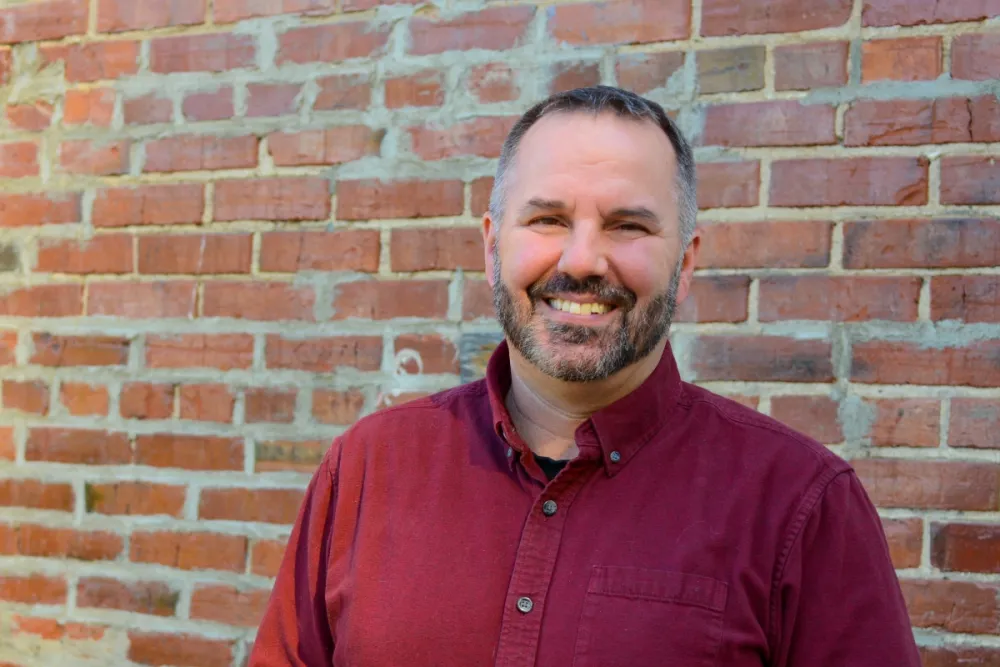
Last September, a familiar face returned to the Pembina Institute when Tim Weis stepped into the role of senior director of Industrial Decarbonization. His connection to the organization, however, spans more than two decades.
Tim first joined the Pembina Institute in 2002. At the time, Canada’s energy landscape looked very different: the oilsands were just beginning their rapid growth, and renewable energy was still on the margins.
Today, he has returned to Pembina at what he sees as a pivotal moment, defined not by whether clean energy solutions exist, but by whether Canada will move quickly and decisively enough to implement them.
The urgency of climate change, Tim says, has not diminished. “We’re still up against the clock.” What has changed is the feasibility of the transition itself.
From early promise to proven solutions
After decades working in climate and energy, Tim has never felt more optimistic — not because the challenge has eased, but because the technologies we need are available, practicable and affordable.
Over the last decade, wind and solar have become the cheapest sources of new electricity in many jurisdictions. Electrification is also accelerating, from electric vehicles to heat pumps in buildings. Technologies that once seemed experimental are now proven and scalable. Globally, momentum is building in a way that simply wasn’t possible 20 years ago.
Pembina’s work on building a clean, reliable and affordable electricity system has shown that clean electricity is not just an environmental necessity, but the backbone of a modern, competitive economy.
For Tim, that shift has fundamentally changed the nature of the work. “I’m more optimistic now than I’ve ever been,” he says. “This is a problem we can solve. The question is: will we do it in time?”
The real challenge: Implementation
Tim believes that the most pressing challenge is no longer envisioning a clean energy future, but realizing it.
Many of the investments needed to decarbonize Canada’s economy, from electricity grid upgrades to building retrofits, require long‑term planning that extends beyond political cycles. Even when projects make clear economic sense, shifts in political priorities can stall progress. New technologies also threaten entrenched interests, creating resistance from incumbents invested in the status quo.
As a professor at the University of Albera, Tim was often asked by his students how they could build careers in the renewable energy industry. That question underscored the importance of stable policy, not only to secure long-term investment, but to attract innovative startups that drive growth.
Promising steps have been taken. Policies like the federal Clean Electricity Regulations align the efforts of Canadian provinces, creating a larger, more competitive market that attracts and retains private-sector interest.
Pembina’s critical role
Tim believes that what sets Pembina apart is its combination of rigour and pragmatism. The organization recognizes both the scale of the opportunity and the complexity of implementation, be it upgrading infrastructure to retrofitting millions of homes.
“Pembina brings realism to the challenge,” Tim says. “It’s about understanding the technical, political and economic realities, not just the ambition.”
That approach is reflected in Pembina’s analysis on how electricity, buildings, and transportation can be decarbonized through electrification.
From vision to implementation
Tim sees the energy transition as being at a critical juncture. Regions like Alberta face a clear choice: prepare for the future or risk being left behind.
Recent analysis of renewable energy uncertainty in Alberta shows how policy instability can quickly derail investment, jobs, and long‑term competitiveness.
“There’s a huge opportunity if we take this transition seriously,” Tim says. “The technologies that felt like pipe dreams 20 years ago are now within reach. Looking back on some of the work I did with Pembina 15 years ago, we underestimated how quickly technology would change. People laughed at our timelines for phasing out coal in Alberta. But Alberta did it even faster than our most ambitious scenario!”
The work ahead is no longer about imagining what a clean energy future could look like. It’s about achieving it at scale while keeping energy available and affordable.
“We’re not dreaming anymore,” Tim says. “The challenge now is making it real — and that’s what makes this moment so exciting.”