
In the next 25 years, electricity will play an increasingly important role in Canada’s economy with demand projected to grow anywhere from one-third to more than double its current level, according to a recent major study by the Canada Energy Regulator (CER).
Canada’s Energy Future 2026 uses four scenarios with different assumptions around economic, energy and policy drivers to project potential futures of Canada’s energy system. But in all cases, it’s clear — there are going to be big changes in the way we generate and use electricity in the next 25 years.
What are the four scenarios the Canada Energy Regulator looked at?
The CER’s Current Measures is a traditional, baseline scenario assuming moderate economic growth, energy prices and technological progress, as well as policies currently in place.
The Higher and Lower scenarios create an upper and lower range around the Current Measures scenario with varying levels of the key drivers, such as Canadian gross domestic product (GDP) growth, data centre electricity demand and liquefied natural gas (LNG) exports. In other words, it accounts for energy and economic uncertainties by creating these outer bounds.
The Canada Net-Zero scenario assumes net-zero greenhouse gas (GHG) emissions for Canada by 2050 and works backwards to where we are today. This explores a faster pace of global climate action, lower clean technology costs and lower global oil and natural gas demand and prices than in the Current Measures scenario.
Each scenario is based on its own set of assumptions and is meant to serve as model scenarios rather than predictions or policy recommendations.
We’ve pulled out four key insights from this study:
- Electricity demand grows significantly through 2050, delivering a much larger share of energy use
- Low and non-emitting technologies generate nearly all electricity in 2050
- Transmission interties between provinces and territories grow significantly
- The electricity sector leads the way for emissions reductions
- Electricity demand grows significantly through 2050, delivering a much larger share of energy use
Electricity demand is set to increase by at least 30 per cent to a maximum of 120 per cent over the next 25 years. The need for additional reliable and affordable electricity will grow out of the widespread adoption of passenger electric vehicles (EV), new industries coming online, and population growth. There’s a wide range of load growth in CER’s scenarios, based on different levels of economic growth and new large loads like data centres.
Electricity also becomes a more important component of the economy in all scenarios, rising from 18 per cent of total energy use today to between 23 and 35 per cent in 2050. Fossil fuels are governed by global markets that can be volatile and affected by geopolitical conflicts, presenting energy security and stability risks. Locally generated electricity, however, provides a more stable alternative with wind and solar already serving as the lowest-cost options for generation. The CER’s report shows that in all cases, Canada will switch away from fuel-based systems to electricity to meet more of its transportation, residential, commercial and industrial needs in the coming decades.
- Low and non-emitting technologies generate nearly all electricity in 2050
Low or non-emitting technologies will generate over 96 per cent of electricity by 2050 in all the CER’s scenarios, up from 80 per cent today. Hydro and traditional nuclear power will stay close to their current levels, while small modular reactors will grow alongside wind and solar. Throughout that time, oil and natural gas without carbon capture are expected to decrease.
Wind, solar and storage technologies will play a key role in our future electricity system, growing from about 7 per cent of generation in 2023 to between 29 and 45 per cent by 2050 (see Figure 1). At the same time as total electricity generation increases, wind and solar increases by between five and 12 times, with wind energy representing a big share of this growth. In short, not only will wind and solar generation jump significantly, but so will its contribution to the overall electricity mix.
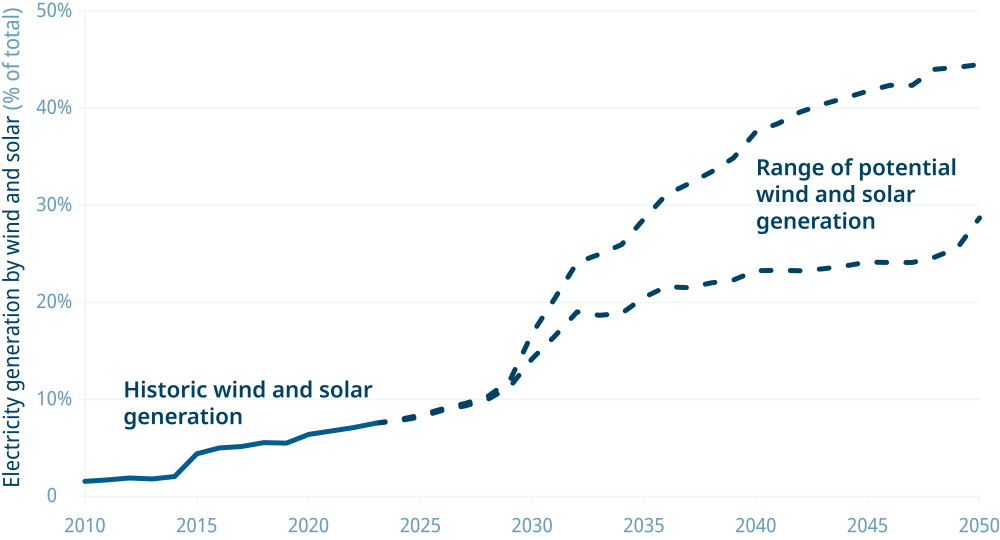
Figure 1: Percentage of wind and solar in Canada’s total electricity generation (2010-2050)
- Transmission interties between provinces and territories grow significantly
As electricity’s role in the economy grows, collaboration between provinces and territories will matter more than ever to balance supply and demand, generate revenue, and ensure energy sovereignty and security. Provinces and territories can help each other meet those needs through increased trade across their borders; for example, B.C.’s large hydroelectric resources are a great match for Alberta’s strong wind and solar potential. The CER expects that connections between provincial grids will grow by roughly 70 per cent by 2050, with the actual trade of electricity within Canada doubling over that same period.
The National Energy Corridor agreement announced in March brings together eight provinces and two territories on this issue and exemplifies the cooperation needed to pave the way for an integrated and reliable grid in the decades ahead.
- The electricity sector leads the way for emissions reductions
Through low and non-emitting technologies, the electricity sector will also have the greatest impact on emissions reductions across the economy. Compared to the 2025 benchmark year, emissions from the electricity sector fall by over 65 per cent across the current measures, higher and lower scenarios by 2050. Figure 2 shows that as the total economy’s emissions steadily decline over the coming decades, the electricity sector’s emissions drop significantly — even in the scenarios where policies remain more or less consistent to the current landscape. Overall, electricity grids will do a lot of the heavy lifting in delivering on Canada’s emissions progress by 2050.
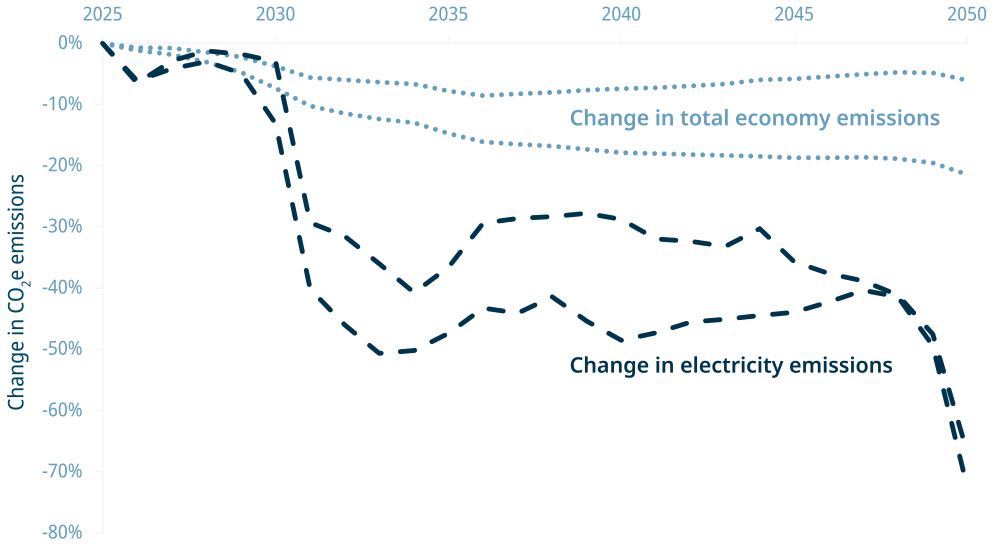
Figure 2: Percentage change of Canadian carbon dioxide emissions in electricity sector and total economy (2025-2050)
The electricity grid certainly has its work cut out for it in the coming decades. There are exciting and promising opportunities to attract investment and create jobs, all while providing affordable and clean electricity.
No matter the scenario, it’s clear that low-cost, reliable and clean electricity are the cornerstone of Canada’s energy future.