
Canada’s energy transition has entered a new phase. Clean technologies are no longer bleeding edge. They are cheap, reliable and scalable. The question is whether key players, policies, and systems can put them to work.
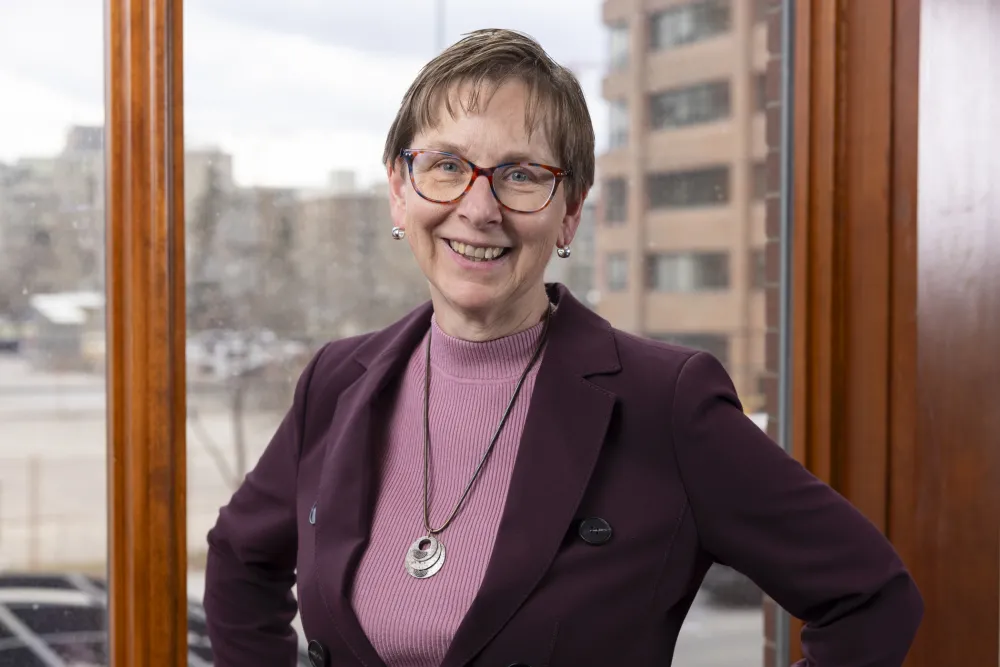
For Monica Curtis, our senior director of Communities and Decarbonization, this is precisely where Pembina’s leadership, grounded in evidence and experience, matters most.
"We’re past the stage of asking if this transition is possible,” Monica says. “Now the work is about doing it well — thoughtfully, fairly, and at scale.”
After a career spanning utilities, consulting, government‑funded agencies, and mission‑driven organizations, Monica joined the Pembina Institute with a clear sense of purpose. What drew her was not just Pembina’s reputation, but its role as an independent, evidence‑based think tank able to respond to fast‑changing market and policy conditions.
From design to delivery
Monica began her career working at the utilities EPCOR and SaskPower, where she built the case for demand‑side management (DSM) and supported the design of customer energy-efficiency programs. She later worked as a DSM implementer and consultant, supporting energy efficiency and financing initiatives across 17 American states.
As the founding CEO of Energy Efficiency Alberta, a provincial agency, she helped deliver large‑scale decarbonization programs funded through carbon levies and championed Alberta’s Clean Energy Improvement Program, a municipal financing mechanism that continues to influence policy thinking across Canada.
Across these roles, Monica developed a practical understanding of how policy performs in the real world. “You can design something that looks perfect on paper,” she notes, “but if it doesn’t work in the marketplace, it won’t deliver the outcomes you want.”
Efficiency first, and always
A consistent thread throughout Monica’s career is an efficiency‑first mindset. For her, energy efficiency is not a niche solution, but a pillar of climate, economic, and social policy.
“Wasting energy is wasting money,” she says. “And when we waste money, we lose opportunities to invest in people, communities, and resilience.”
This perspective shapes her current focus at Pembina, where she has elevated DSM and efficiency alongside decarbonizing energy supply. Pembina’s research shows that DSM is a proven, cost‑effective climate solution that lowers energy costs, improves grid reliability and delivers economic benefits.
In her view, embedding efficiency into transportation, building codes, retrofit programs, and utility planning is essential to achieving affordability, climate competitiveness and emissions reductions, all at the same time.
“We already have enough technology to make meaningful progress on climate,” Monica explains. “The challenge now is regulation and navigating the complexity of provincial jurisdictions where most of that work actually happens.”
Navigating complexity, choosing focus
From coal phase‑outs to industrial carbon pricing, Canada has made meaningful progress over the past decade. Monica, however, is candid about the challenges ahead. Many early climate efforts focused heavily on federal action, but it is provinces, territories and municipalities that govern implementation, delivered by the private sector.
“In a federation like Canada, the sheer number of decision‑makers is enormous,” she says. “As we move from innovation to implementation, that complexity only increases.”
At Pembina, that means identifying and filling research gaps and convening the influencers who can turn findings into action.
“No one organization can do it all. Our job is to do the research and focus on the facts,” she explains. “That’s how evidence actually moves systems.”
Reframing the conversation
Monica is particularly energized by the opportunity to shift how climate action is understood: not as a trade‑off, but as a pathway to economic and social benefit.
“Economic policy is climate policy,” she says. “When people see that connection — in lower costs, better health, stronger communities — the conversation changes.”
Looking ahead, Monica is less concerned with reaching discrete milestones than with maintaining momentum. Success, in her view, means continuing to make incremental progress, avoiding backsliding and ensuring that today’s decisions build systems capable of deeper change tomorrow.
“This moment is challenging,” she reflects, “but it’s also full of opportunity if we stay grounded in the evidence and clear about what actually works.”