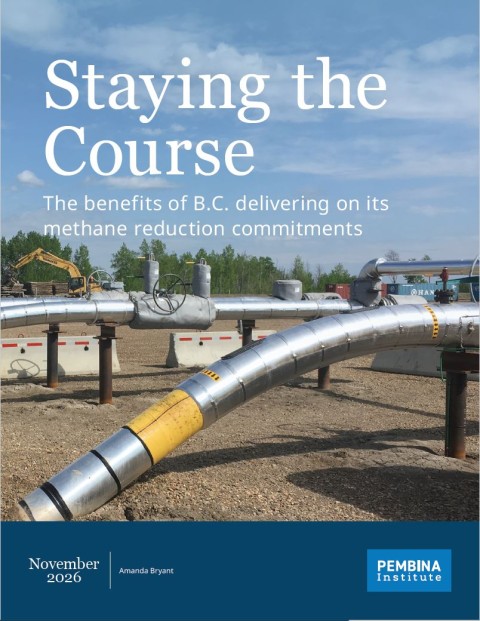
British Columbia’s CleanBC plan includes targets to reduce oil and gas methane emissions 75%
below 2014 levels by 2030 and to achieve near-elimination of industrial methane emissions by
2035. This report finds that delivering on these 2030 and 2035 targets will bring real, quantifiable benefits to the province, including increased natural gas revenues for producers and royalties for government, net social benefits, well-paying jobs, and globally exportable methane technology and expertise.
Opportunities remain to strengthen the province’s approach by clearly defining what constitutes
“near-zero” methane emissions by 2035, developing regulations for all affected sectors, and
continuing to expand monitoring, measurement, verification and enforcement activities.
Nevertheless, the Pembina Institute urges the B.C. government to stay the course with its
approach to regulating and reducing oil and gas methane emissions.
B.C. has established itself as a leader in reducing methane emissions from the oil and gas sector.
According to Environment and Climate Change Canada’s 2023 National Inventory Report, oil
and gas methane emissions in the province were 52% below 2014 levels by 2023, allowing B.C.
to meet and surpass its 2025 methane reduction target two years early. Over the same period,
marketable natural gas production increased substantially, demonstrating that methane
emissions can be reduced while maintaining production growth.
Methane reduction is a high-impact and relatively low-cost means of slowing the effects of
climate change. In the first instance, effective methane policies lower emissions of a highly
potent greenhouse gas. They also have the co-benefits of conserving natural gas that would
otherwise be lost to the atmosphere, generating economic value for producers and government,
and supporting employment and innovation in methane mitigation and measurement.
Delivering on B.C.’s methane commitments also strengthens the province’s reputation as a
producer of relatively low-methane-intensity natural gas and helps position it to respond to
growing international interest in lower-emissions energy imports.
This report finds that the implementing the regulations and meeting the reduction targets would
have measurable co-benefits, including:
- An estimated 1,543 kt of cumulative methane emissions reductions between
2018 and 2035 as methane emissions continue to decline under existing targets and
regulations - Approximately $1.1 billion in net benefits in this same time period, after accounting
for compliance costs, the value of conserved gas and avoided climate damages estimated
using the social cost of methane, which factors in $186 million in cumulative gross revenue that producers would earn from conserved natural gas under a moderate price scenario, with estimated revenues ranging from $110 million to $270 million under low- and high-price scenarios - Potential cumulative government royalties of approximately $26 million,
with estimated royalties ranging from $16 million to $36 million depending on natural gas prices and royalty rates - A globally competitive methane intensity that strengthens B.C.’s position as a
supplier of lower-methane-intensity natural gas and supports access to markets such as
South Korea, Japan, and the European Union that are increasingly focused on emissions
performance - Support for high-quality employment in methane mitigation and
measurement, including the development and export of B.C.-based technology,
services and expertise
B.C.’s experience demonstrates that strong methane regulations can deliver measurable
environmental and economic benefits. By staying the course on existing commitments and
continuing to improve regulatory certainty and implementation, the province can build on its
record of success, generate additional value from conserved natural gas, support well-paying
jobs, and continue reducing oil and gas sector emissions.
However, while B.C.’s natural gas production may have a relatively low emissions profile, this
should not be viewed as a rationale for further LNG expansion. Significant lifecycle emissions
uncertainties, environmental impacts, high project costs, and growing competition from lowercost
suppliers make further LNG expansion inadvisable for B.C, despite the importance of
ensuring production for existing exports remains comparatively low-emissions.