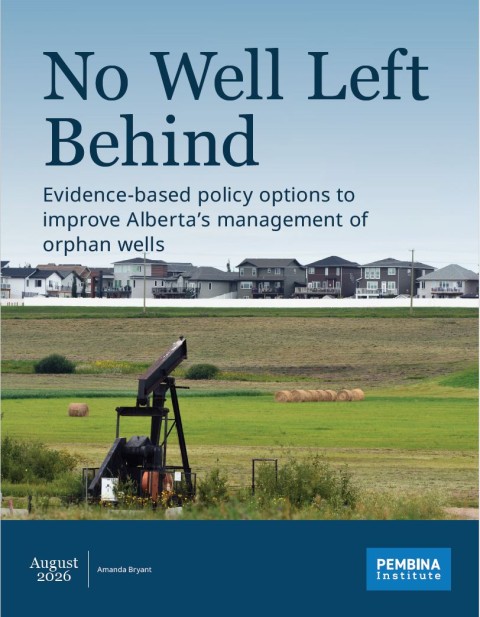
Alberta faces a growing orphan well crisis that poses significant risks to the environment and to the provincial economy. Orphan wells are non-operating oil and gas wells with no responsible owner. They often become orphaned when the most recent owner becomes insolvent without decommissioning the well or reclaiming the land. Orphan wells can leak methane and other pollutants, contaminate land and water, and pose health and safety risks to the public. The scale of the problem continues to worsen, driven by weak policy and insufficient financial safeguards.
This report provides an overview of existing and proposed policies to address orphan wells specifically and oil and gas liabilities more broadly. We argue that there is a need for sound public policy that manages economic liabilities and mitigates human and environmental harms more effectively than current policies, which too often fail to uphold the legal principle that polluters must pay to clean up after themselves. We summarize the main findings of two independent research projects: methane measurements conducted by McGill University and economic modelling performed by Environmental Defense Fund (EDF). We then develop policy recommendations based on that research and our own assessment of policy gaps.
Key research findings
The findings below are based on preliminary results from measurements conducted at 143 orphan wells in Alberta and British Columbia by McGill University, EDF’s cash flow analysis of nearly 130,000 unplugged wells in Alberta, and our own analysis of policy gaps.
- While average emissions from individual orphan wells are low, a small proportion of high-emitting wells accounts for the majority of emissions.
- Annual methane emissions from orphan wells in Alberta and B.C. may exceed 30 kilotonnes of methane, equal to the emissions from consuming over 320 million litres of gasoline or over 1.7 million barrels of oil.
- Most unplugged wells in the cash flow analysis (76%) have a negative net-present value and are therefore likely to become liabilities.
- In addition, approximately one-third of the unplugged wells analyzed are at risk of becoming orphans.
- Plugging all wells at risk of becoming orphans would create over 40,000 jobs.
- An escalating inactive well fee can disincentivize long-term inactivity and make plugging the economically optimal decision for operators.
- Governance gaps, including an insufficient orphan well levy and a lack of upfront security requirements comparable to the stringent security requirements placed on new renewables projects, increase the risk of more wells being orphaned.
Recommendations
- Investigate and address regional variation: Collect and analyze region-specific data on orphan well characteristics and methane emissions and develop tailored mitigation strategies.
- Identify and plug high emitters: Prioritize identification and mitigation of high-emitting wells and introduce monitoring and follow-up requirements for known problem wells.
- Define operator health rigorously: Establish a clear and transparent definition of operator financial health that is stringent enough to prevent the economic burden of well cleanup falling on the public.
- Impose an escalating inactive well fee: Introduce a fee structure that makes prolonged inactivity more costly than plugging, with safeguards to prevent gaming the system.
- Increase the orphan well levy: Scale industry funding to match current and anticipated liabilities, ensuring that the non-profit Orphan Well Association can fully meet its mandate to close orphaned wells without reliance on public funds.
- Establish fair security requirements for new energy projects: Require upfront security for new wells that is at least on par with that required of the renewables industry and is based on realistic and transparent closure cost estimates.