
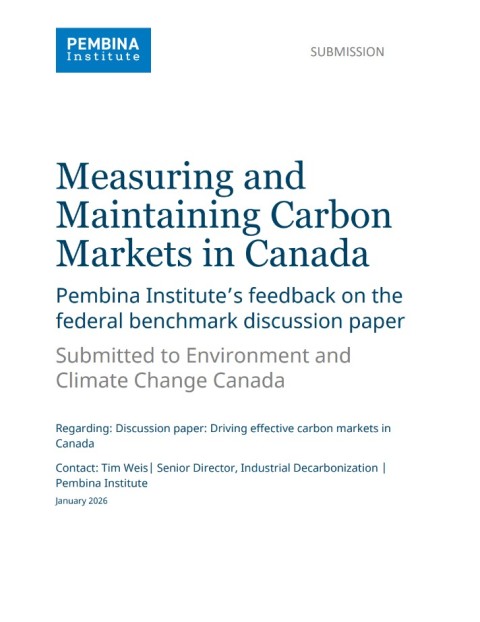
In January 2026, the Pembina Institute submitted feedback to the federal government regarding Environment and Climate Change Canada’s discussion paper, Driving Effective Carbon Markets in Canada.
Download a copy of our full submission. You can also download a two-page summary of our feedback.
Key recommendations
- Implement annual market‑function tests: Require carbon pricing systems to meet clear outcome-based tests consistent with the federal benchmark—such as maintaining an effective compliance price of at least 75% of the headline price and ensuring sustained net demand for credits— in order to prevent oversupply and preserve a credible price signal.
- Clarify enforcement and backstop triggers: Establish independent, automatic criteria based on annual compliance price and net demand tests to identify failing systems and trigger timely corrective action or implementation of the federal backstop.
- Protect the carbon price signal: Exclude mechanisms such as emissions reduction accounts that risk undermining the price signal by weakening credit demand and facilitating double counting.
- Expand and harmonize coverage: Ensure pricing systems are applied consistently across provinces and include smaller facilities, especially oil and gas, where sectoral emissions coverage gains outweigh administrative costs.
- Improve data transparency and reporting: Require regular public reporting of credit prices, trading volumes, supply–demand balances, and compliance outcomes, with confidentiality granted only where clearly justified.
Strengthening these elements will ensure that output-based pricing systems (OBPS) across Canada remain fair, effective, and aligned with federal obligations.