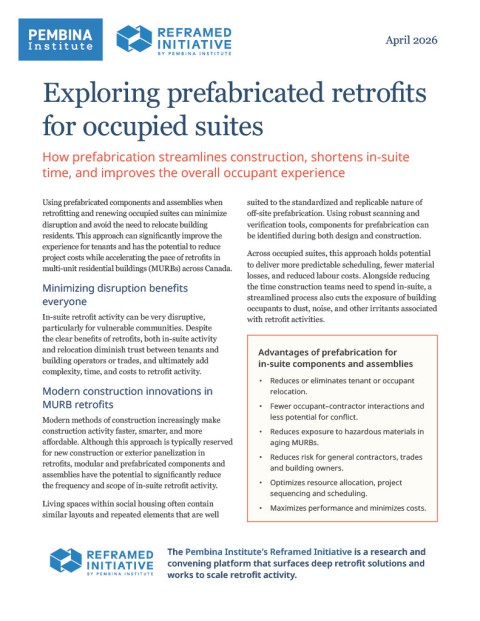
Using prefabricated components and assemblies when retrofitting and renewing occupied suites can minimize disruption and avoid the need to relocate building residents. This approach can significantly improve the experience for tenants and has the potential to reduce project costs while accelerating the pace of retrofits in multi‑unit residential buildings (MURBs) across Canada. This primer explores how prefabrication can streamline construction, shorten in‑suite time, and improve the overall occupant experience.
Advantages of prefabrication for in‑suite retrofits
- Reduces or eliminates tenant or occupant relocation
- Fewer occupant–contractor interactions
- Reduced exposure to hazardous materials in aging MURBs
- Reduced risk for contractors, trades, and building owners
- Improved project sequencing, scheduling, and resource allocation
- Maximized performance with minimized costs
Modern construction innovations in MURB retrofits
Modern methods of construction increasingly make construction activity faster, smarter, and more affordable. Modular and prefabricated components and assemblies have the potential to significantly reduce the frequency and scope of in‑suite retrofit activity. Living spaces within social housing often contain similar layouts and repeated elements that are well suited to the standardized and replicable nature of off‑site prefabrication. Across occupied suites, this approach holds potential to deliver more predictable scheduling, fewer material losses, and reduced labour costs.
French available upon request.