EDMONTON — Ratepayers in Alberta are overpaying for their electricity bills due to low-cost renewable energy being wasted at record rates – and the problem is set to get even worse under forthcoming electricity market rules, according to new analysis from the Pembina Institute.
A failure to build enough power lines in southern Alberta – to carry electricity from where it is generated, to large population centres where it can be used – is resulting in record levels of what is called “curtailment,” when power generators have to shut-in their operations as there is no way of getting electricity to consumers. The report projects that, unless curtailment issues are addressed, Albertans could shortly be overpaying on their annual electricity bills by more than $260m.
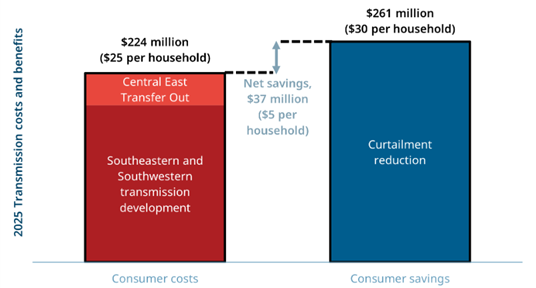
However, the report argues, adding the cost of two new transmission lines in southeast and southwest Alberta to the transmission that is already underway elsewhere in the province, would bring total transmission costs borne by ratepayers to $224m annually – meaning the cost of alleviating curtailment would be more than covered by the subsequent savings consumers would make.
Further, resolving congestion issues in southern Alberta is one of the best practical steps Alberta could take to encourage more wind and solar developers to start building in the province again. If more wind and solar were to come online, consumer bills would only decrease further.
Turning wind turbine blades out of the wind and unplugging solar panels
In practice, curtailment means wind turbines regularly having their blades rotated out of the wind, and solar panels being disconnected, because transmission lines are simply unable to carry any more electricity. Curtailment has now reached record levels - increasing from almost nothing in 2020 to more than 1,400 GWh in 2025. This represented roughly 8% percent of renewable generation last year – and would have been enough to power 200,000 homes.
The wastage of low-cost wind and solar energy, even on very sunny and windy days, is already pushing up costs for consumers – largely because the Alberta Electric System Operator (AESO) applies an additional “rebalancing” charge when it has to seek out other generators to fill supply gaps. In 2025, this charge alone cost ratepayers $17m.
However, costs are expected to rise even higher under new electricity market rules taking effect in 2028. Under the new system, the higher-cost generator that is called upon to fill supply gaps caused by curtailment will now set the price for the entire market (rather than receiving a “rebalancing” payment). This means, in essence, the changes introduced under the restructured electricity market will dramatically increase the cost of curtailment and, as a result, raise rates for Alberta ratepayers.
This curtailment could be addressed by building more transmission lines, something the AESO had previously planned to do, before shelving those plans due to new transmission regulations implemented by the Government of Alberta. The new rules mean the AESO can no longer site transmission based purely on minimising congestion, but must instead perform a cost-benefit analysis for each new line. The report argues that, given consumer savings will outweigh costs, these transmission lines should be expedited – especially if Alberta wants to demonstrate its ongoing commitment to creating an affordable, emissions-free grid, per the memorandum of understanding signed with the federal government last year.
Quotes
“At a time when other jurisdictions such as the UK and Australia are literally giving electricity for free to customers when renewables are abundant, instead Alberta’s market structure and transmission rules are forcing operators to waste vast quantities of low-cost wind and solar power. The good news is there is a solution here – building more transmission lines. Our report shows this is cost-effective for Albertans – and those cost benefits will only increase over time.”
— Will Noel, Senior Analyst, Pembina Institute
Quick facts
- Curtailment of wind and solar increased from almost nothing in 2020 to more than 1,400 GWh in 2025, representing roughly 8% of renewable generation that year – enough to power 200,000 homes.
- This is high by international standards. Globally, jurisdictions with similar shares of wind and solar in their grids as Alberta have curtailment rates between 0.1%-4.2%.
- Under forthcoming new electricity market rules due to come into force in two years’ time, when wind and solar is curtailed, all electricity will be priced according to the highest-cost generation that is dispatched. In most cases, this is natural gas.
- If these rules had been in place in 2025, wind and solar curtailment would have increased average electricity prices by approximately $5.4/MWh (13% higher than if congestion had not occurred). In total, this would have driven up electricity costs for Albertans by $261m (roughly $30 per household).
- The Alberta Electric System Operator previously estimated the cost of building two new transmission lines in southern Alberta at $2.5bn. These lines would be enough to alleviate most of the current congestion issues, and dramatically reduce the wastage of renewable energy.
- The building of these lines is currently on hold, owing largely to provincial anxieties about burdening rate payers with transmission construction costs. However, we find that this cost would be fully covered by the savings consumers would experience as a result of the maximized use of low-cost renewable energy. We estimate the lines would cost $224m per year over 30 years (or $25 per household). Given the $30 per household savings, this would leave every household roughly $5 better off per year.
- Building these lines is also one of the best practical steps Alberta could take to encourage more wind and solar developers to start building in the province once again. If more wind and solar were to come online, consumer bills would only decrease further.
[30]
Download a copy of our report Lost in Transmission.
Contact
Bhan Gatkuoth
Senior Communications Lead
587-742-0818
Background
Report: Path of Most Resistance
Infographic: $40 billion in low-carbon projects at stake in Alberta-federal MOU
Letter: Joint letter to Prime Minister Mark Carney on Alberta-federal MOU