
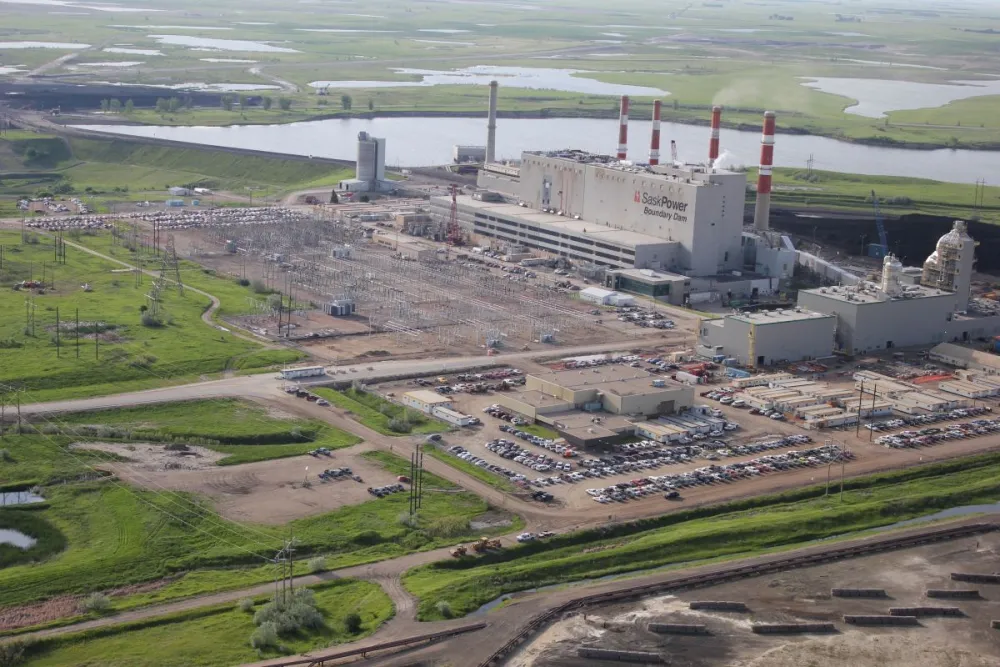
CALGARY — New independent analysis conducted by the Pembina Institute confirms Saskatchewan’s plan to extend coal-fired power to 2050 is one of its most expensive electricity options, costing tens of billions more than modern and viable alternatives. This is a move that threatens to raise costs just as Canada braces for the economic fall out of the quickly advancing trade war with the United States.
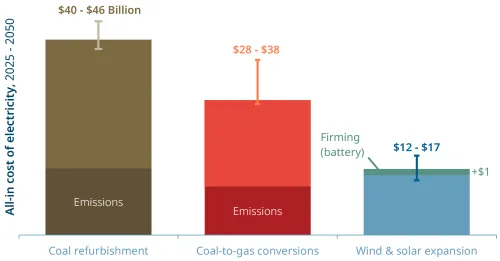
Altogether, the analysis finds that continued reliance on coal would cost between $26 billion and $32 billion. By comparison, converting coal plants to natural gas would cost $18 billion to $25 billion, while expanding renewables would cost just $12 billion to $17 billion, plus roughly $1 billion in battery energy storage.
In other words, delaying the coal phase-out from 2030 to 2050 would cost more than twice as much as generating electricity from renewable energy, locking in higher prices at a time when households, businesses, and industries can least afford them.
The report comes as electricity demand is expected to nearly double or even triple over the next 25 years in the province and argues that the implications of Saskatchewan’s electricity plan go far beyond system costs exposing consumers to steady rate increases and a more outdated and unreliable electricity system overall.
Continued reliance on coal will double electricity rates: SaskPower
Saskatchewan residents already pay some of the highest electricity rates in Canada, and internal SaskPower documents suggest those costs will double by 2040 under the province's current approach.
Limiting further rate increases will require robust electricity planning that prioritizes flexibility and reliability, phases out coal, and increases the share of renewables – all of which can be achieved at a fraction of the projected costs of the government’s current coal extension plan.
These are opportunities that jurisdictions across the world are taking advantage of as they quickly turn to a diverse mix of energy solutions to deliver consistent and reliable power while prioritizing affordability.
With its coal-extension, Saskatchewan becomes Canada’s last coal-dependent province
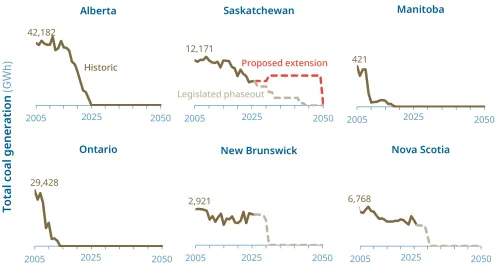
Most Canadian provinces have already moved beyond coal or are on track to do so by 2030. For example, Alberta, Saskatchewan's similarly fossil fuel-dependent neighbor, completed its coal phase-out in 2024, six years ahead of its original timeline.
With its decision to extend the life of its coal plants, Saskatchewan is thus poised to become Canada's last coal-dependent province and stands increasingly misaligned with national and global energy trends, placing its economy, industries, and consumers at an economic disadvantage as the world prioritizes lower-cost and lower-emitting electricity solutions.
The move also puts the province out of step with federal emissions regulations and equivalency agreements on at least three separate accounts, creating additional regulatory, financial, and legal risks while increasing total national electricity emissions over the next 25 years by 15% compared to a 2030 coal phase-out.
Analysis spells opportunity for Saskatchewan, especially now, as economic conditions tighten across the Canadian economy
The plan to extend coal emerges just as Canada embarks on one of the largest electricity expansions in its history to support increasing demand from industrial growth, electric vehicles, building electrification, and more.
Saskatchewan, home to some of Canada's best wind and solar resources, is well positioned to benefit from this transition, but as our report confirms, it is instead choosing one of the most expensive and outdated paths forward. These are choices other governments are quickly turning away from, recognizing that clean electricity is increasingly becoming one of the key economic advantages of the modern electricity era – not least because you can’t tariff the sun or block the wind.
By choosing to remain tied to one of its dirtiest and most expensive electricity options, Saskatchewan will not only isolate itself from global and national energy trends, it will also lock in higher costs for decades to come. This decision will be acutely felt by Saskatchewan residents, just as turbulent trade and tariff conditions drive costs up across the entire economy. As the costs of wind, solar, and battery storage continue to fall, this research urges the government to reconsider and join the rest of Canada - and much of the world – as it turns away from outdated and expensive energy solutions and toward modern ones that ensure affordability, reliability, and lower emissions.
Quotes
“Saskatchewan doesn't need to choose between affordability and reliability as it maps out the future of its electricity system. Proven, clean, and lower-cost alternatives exist today, and the province has a real opportunity to benefit from these solutions while avoiding significant rate increases for consumers and billions in unnecessary costs. The current trade instability, and the threat it poses to affordability, only makes this transition more important.”
— David Pickup, director of Electricity, Pembina Institute
Download a copy of our new report Burning Questions.
Quick facts
- Saskatchewan’s electricity demand is projected to nearly double or triple over the next 25 years.
- Saskatchewan’s plan to extend and refurbish coal is estimated to cost $26–32 billion. Instead, other technologies can deliver the same amount electricity at a far lower cost: a conversion to natural gas ($18–25 billion), or an expanded supply of wind and solar ($12–17 billion, plus an additional $1 billion for battery storage).
- Renewables currently rank as the lowest-cost source of new electricity generation in Canada, expected to further decrease by 25–50% over the next decade.
- Electricity bills in Saskatchewan are already among the highest in Canada. According to internal SaskPower documents, the coal extension plan could double rates by 2040.
- Most Canadian provinces have already moved beyond coal or are on track to do so by 2030, in line with federal law.
- Ontario phased out aging, publicly-owned coal plants in 2014, and Alberta, a province once heavily reliant on coal, eliminated its consumption six years ahead of schedule in 2024.
- The two provinces’ coal phase-outs alone accounted for roughly 80% of Canada’s total emissions reductions between 2005 to 2023.
- While Saskatchewan is responsible for roughly 3% of Canada’s electricity generation, it currently represents nearly a quarter of national electricity emissions due to its reliance on coal.
- Saskatchewan has one of the most carbon-intensive grids in Canada, with around 71% of electricity supplied from fossil fuels in 2025.
- If Saskatchewan delays its coal phase-out by 20 years, Canada's total electricity emissions would be 15% higher than if coal is phased out by 2030. The added pollution would be comparable to the annual emissions of the Netherlands.
- Coal pollution could increase rates of respiratory illness and pollution-related fatalities for nearby communities, leading to an additional $160 million to Saskatchewan healthcare spending.
- Jurisdictions such as Texas, California, and Denmark have strengthened grid reliability using energy storage, transmission links, and demand-response programs. Saskatchewan can achieve similar results while reducing costs and phasing out coal.
Contact
Bhan Gatkuoth
Senior Communications Lead, Pembina Institute
587-742-0818
Background
Blog: Saskatchewan is going in the wrong direction on coal
Infographic: Health Implications of Saskatchewan’s Delayed Coal Power Phase-out