
EDMONTON — The Alberta government’s current plan to reduce emissions from its electricity sector is overly reliant on relatively untested technologies that amount to “risky bets,” according to new analysis from the Pembina Institute.
Negotiations between Alberta and the federal government on the future of electricity regulation in the province are due to conclude by April 1. Alberta could see the federal Clean Electricity Regulations suspended for the long term, in favour of equivalent provincial rules. But, the report argues, this should only happen if the province presents a credible alternate plan during memorandum of understanding (MOU) talks, forming the basis of an equivalency agreement with the Government of Canada.
The report, Path of Most Resistance, urges negotiators to rigorously examine Alberta’s proposed plan, given that to date the province has demonstrated a preference for relatively untested and uneconomic technologies to decarbonize its electricity sector. An overreliance on these, the report argues, would pose risks to Alberta’s MOU commitment of reaching net-zero electricity emissions by 2050.
Key findings include:
- The majority (76 per cent) of emissions reductions that the Alberta Electric System Operator (AESO) models to 2040 relies on widespread deployment of carbon capture at natural gas-fired power plants and some switching to hydrogen-fired generation. This is despite the AESO having previously labelled both technologies as “early stage.” Private investment tells the same story: interest in gas‑with‑CCS in Alberta has been thin, punctuated by the high‑profile cancellations of the planned CCS projects at the Genessee and Shepard plants in 2024.
- Beyond 2040, the AESO expects nuclear power to play a major role in adding emissions-free capacity to the grid, despite the technology being entirely new to Alberta.
- While the AESO also models some growth in renewables to 2040, the latest data on the state of Alberta’s renewables market calls into question the likelihood of such growth without policy changes to rebuild investor confidence. Real-world data shows a 93 per cent drop in new installed wind, solar, and storage capacity last year compared with the peak year (2022). In 2025, Alberta added only 137 megawatts (MW) of solar and no wind or storage — likely a direct impact of the 2023 provincial moratorium on wind and solar approvals, and subsequent restrictive policies, many of which remain in place.
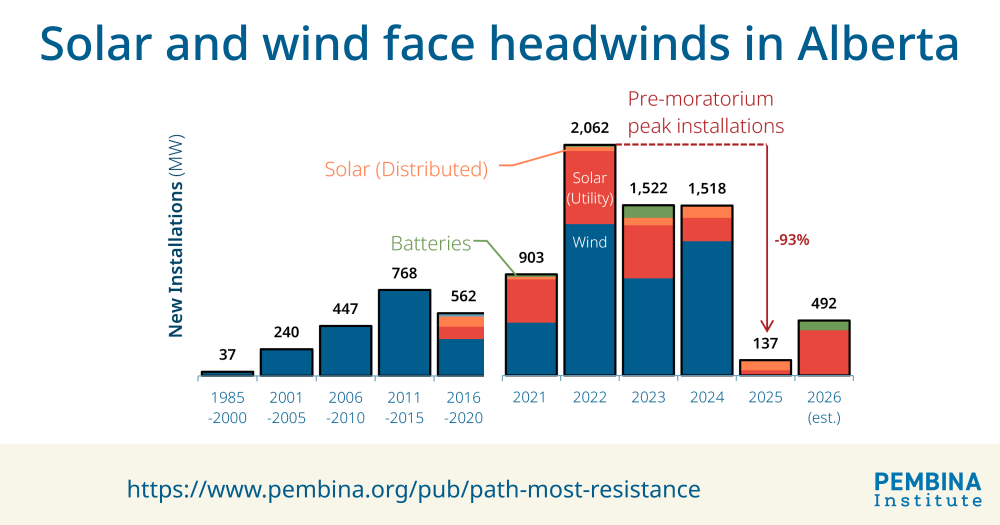
Overall, the report highlights that negotiators should look for a pragmatic approach, focusing on early emissions reductions through near-term growth of proven technologies where investment is ready to be deployed (wind, solar and storage). To do so, the MOU talks must include commitments from Alberta to remove or reduce barriers to renewables investment that have been implemented in the last few years.
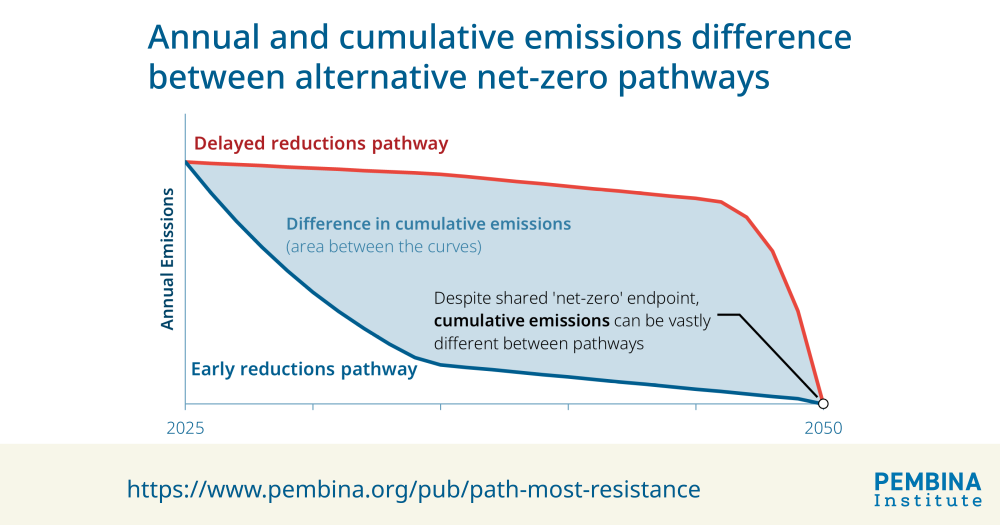
Doing so would also ensure Alberta is on a reasonable path towards achieving the same cumulative emissions as it would have under the Clean Electricity Regulations. Though both the provincial and federal governments have recommitted to the target of net-zero electricity emissions by 2050, a delayed reduction pathway that hedges on a large portion of Alberta’s emissions reductions coming from CCS and nuclear being up and running in the 2030s and 2040s, if ever, would in fact result in far greater emissions entering the atmosphere — an outcome the negotiators should seek to avoid, if the regulatory principle of equivalency is to be upheld.
The Pembina Institute urges the federal and Alberta governments to reach a negotiated agreement with a real chance of success. In addition to helping Alberta hit its net-zero by 2050 target, removing regulatory barriers to low-cost wind and solar development would re-start potentially billions of dollars of new investment — both in the electricity sector itself, and in other sectors looking to purchase affordable low-carbon power. This would help diversify the economy and speed up the process of making the electricity grid more affordable and resilient for all Albertans.
Quotes
“The question here isn't whether Alberta has a right to come up with its own plan to make its electricity grid emissions-free by 2050. The question is: how credible is that plan? Alberta must show it has done the math and is able to deliver emissions reductions using technologies that are both most affordable and most likely to actually be deployed at scale, instead of waiting for those that are still relatively untested or needlessly expensive.”
— Will Noel, senior analyst, Pembina Institute
Key facts
- In 2025, less than one-fifth of new wind, solar and battery capacity installed in Canada was installed in Alberta — an exact reversal of the trend in the early 2020s, when four-fifths of renewables capacity added in Canada was installed in Alberta.
- Of the 98 carbon capture and storage facilities proposed in the power sector worldwide before 2017, only two have actually been installed (both on coal power plants), representing a success rate of two per cent.
- In Alberta specifically, two of the seemingly more promising CCS projects — retrofits at Genessee and Shepard combined-cycle natural gas plants — were both shelved in 2024, with investors citing economic infeasibility. Of the remaining proposals, most have not made concrete commitments to CCS, but are rather self-identifying as “CCS ready,” which in practice means that CCS could be installed at a later point, but does not indicate any specific intention to in fact do so.
- Alberta remains the largest source of electricity emissions in Canada, generating approximately half of national emissions, while representing less than one-fifth of supply.
Previous Pembina Institute research has found that, across a range of jurisdictions, high levels of wind and solar are being achieved, without undermining the reliability of electricity systems.
[30]
Contact
Hanneke Brooymans
Senior communications lead
587-336-4396