Diesel is the lifeline of remote northern power systems but also the greatest vulnerability. Communities depend on it for reliable electricity, but aging infrastructure, soaring fuel prices and volatile supply chains require ever-increasing diesel subsidies to shield households and businesses from the true cost of generating power. Across the North, diesel subsidies are essential to maintaining affordable electricity rates, however, they also, unintentionally lock communities into long-term diesel dependence.
That is, until several rural Alaskan communities found a way to redirect what was essentially a diesel subsidy into an opportunity to develop community-owned renewable energy. Instead of letting the subsidies evaporate as diesel use declined, they found an innovative way to optimize them to support affordable, clean energy.
This blog explores how Alaska reimagined its energy subsidy program to enable renewable energy and asks how Canada can apply the same lessons to empower Indigenous and community-led clean energy in remote diesel communities.
Diesel subsidies do not support long-term affordability
Generating electricity in remote diesel communities in Canada’s North comes at a high cost, further exacerbated by urgent, critical infrastructure needs. Publicly funded fossil fuel subsidies and electricity rate setting policies are used to lower rates for utility customers. Despite these efforts, remote communities pay six to 10 times more for energy than the rest of Canada.
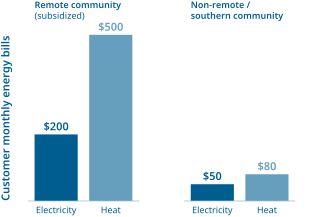
While subsidies play a critical role in the affordability of electricity in remote diesel communities, they also complicate the transition to more sustainable energy sources. This is because subsidies artificially bring down the cost of diesel and make other sources of energy like wind, solar and hydro appear more expensive in comparison. This issue is compounded by the way electricity generated by Independent Power Producers (IPPs) is priced; the rate paid for renewable generation is often tied to the subsidized cost of producing the same electricity with diesel, rather than the higher, un-subsidized costs that would more fully reflect their value. This makes it difficult for community-owned IPPs to demonstrate a bankable, financially viable business case for their projects.
How renewable energy impacts utility subsidies in Alaska
Electricity in Alaska’s rural villages is also exorbitantly expensive at three to five times the cost of the state’s urban and road-connected regions. This is largely because rural communities rely on high-cost diesel generation while urban areas benefit from cheaper energy sources and energy infrastructure, much of which was developed with public spending. Alaska responded to this price inequity by creating the Power Cost Equalization (PCE) program, which provides financial support to rural utilities, lowering electricity rates.
Funded by earnings from a state-managed endowment trust (Power Cost Equalization Endowment), the PCE provides rural utilities with grants that are equal to the difference between the actual cost of generating electricity in remote communities and a base rate determined by the average residential electricity costs in Anchorage, Fairbanks and Juneau.
The PCE program was designed when diesel was the main source of electricity in rural communities. At the time, the subsidy amount was based on the amount of diesel fuel used. This created unintended impacts when locally owned utilities (tribal, municipal and cooperatives) began developing renewable energy. As renewable energy displaced diesel generation, the eligible costs used to calculate PCE payments also dropped. This resulted in smaller subsidy payments, and consequently, higher electricity bills for residents.
Independent power producers (IPPs) emerged as an important work around to these issues. Because the cost of purchased power is an eligible PCE expense, IPPs could develop renewable energy projects and sell the electricity to local utilities without eroding the PCE subsidies, even as diesel use declined. In practice, subsidy calculations shifted from diesel fuel to purchased renewable power, keeping PCE payments and residents’ energy bills stable. By repurposing a subsidy mechanism originally designed around diesel to support cleaner purchased power, remote communities were able to maintain access to energy affordability subsidies while establishing a stable environment for community-owned renewables.
Applying Alaska’s model in Canada
Canadian governments can expect to spend millions of dollars on diesel subsidies to keep electricity affordable in remote communities every year, far into the future. However, as renewable energy projects reduce the need for diesel, they also reduce diesel‑related subsidies, with the resulting savings flowing back into general government revenues rather than remaining in the community. Alaska avoided this outcome by developing community-owned IPP clean energy projects, which preserve the flow of subsidies regardless of declining diesel consumption.
Instead of committing to exorbitant subsidies year after year, Canada could take a different approach by taking the money that governments expect to spend on subsidies into the future and creating a long-term renewable energy transition fund with that money now. This means setting aside the projected future spending on diesel subsidies as the starting investment. The interest earned on this investment could then be used to support the development of renewable energy.
In this way, the transition fund could achieve a similar result to the PCE. As diesel usage decreases, the flow of subsidies would not change, but instead would shift from fossil fuels to renewable energy, effectively paying for the transition with the money the transition itself saves.
Lessons learned from Alaska’s PCE show us that IPPs bring more local value when they are supported by strong public policy that doesn’t erode subsidies as diesel usage drops. Canada’s remote energy transition could benefit from building IPP and Indigenous ownership models that don’t just avoid negative impacts to ratepayers but actively reinforce long-term affordability and community economic development.