

Canada is not on track to meet its 2030 climate target. The latest federal data shows national emissions are just 10.3 percent below 2005 levels, which is the weakest performance in the G7, and the Prime Minister has acknowledged the 2030 goal is out of reach.
Globally, the picture is equally stark. The United Nations Environment Programme's Limiting Overshoot report confirms what scientists have long warned: crossing the 1.5°C threshold is now virtually unavoidable within the next few years. Under current policies, the world is heading toward 2.6°C of warming or more by the end of the century.
Timelines that once felt distant are now upon us. That shift fundamentally changes which tools belong in the conversation.
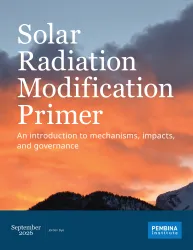
This is the context for the Pembina Institute’s latest primer, released today: a plain-language introduction to solar radiation modification (SRM). SRM refers to proposed technologies that intentionally reduce the amount of solar energy reaching Earth's surface. The most discussed method, stratospheric aerosol injection (SAI), would involve intentionally altering the planet's atmosphere at a scale humanity has never attempted. That is not a small proposition, nor should it be treated as one.
Discomfort with a technology is no reason to ignore it, especially as the gap between climate reality and policy action continues to widen. When a major country falls this far behind its commitments, the conversation about emergency measures becomes harder to avoid.
SRM in the climate toolkit
It helps to view SRM as one distinct instrument within a broader portfolio targeting four distinct links in the chain driving climate change:
- Emissions reductions work by reducing the amount of greenhouse gas emissions entering the atmosphere, primarily through shifts in the energy system. Emissions reduction is, and needs to remain, the primary response to climate change.
- Carbon dioxide removal (CDR) aims to remove previously emitted CO2 and store it durably. CDR requires decades of sustained, large-scale deployment before yielding a measurable reduction in global mean temperature.
- Adaptation focuses on disrupting the final link in the chain: the on-the-ground harm experienced by populations.
- Sunlight reflection (SRM) lowers the amount of solar energy that can reach the surface of the Earth by increasing the Earth's reflectivity. SRM is the only intervention capable of cooling the planet over years, not decades.
This potential speed explains why SRM is now a serious policy debate across the UN, the European Union, the United Kingdom, and the United States.
Economics drives much of this urgency. Estimates suggest deploying SAI to lower global temperatures by 0.5°C to 1.0°C could cost tens of billions of dollars annually. By comparison, fully decarbonizing the global economy requires roughly $9.2 trillion per year.
That massive cost discrepancy is precisely why Canadian environmental organizations and policymakers cannot sit on the sidelines. A technology affordable enough for a single nation, or even a wealthy individual, to deploy unilaterally should not be left to chance.
Risks and uncertainties
Evaluating SRM requires a risk–risk framework that compares the risks of intervention with the ongoing risks of unmitigated climate change. None of this implies SAI is safe or straightforward. The primer details specific hazards:
- Termination shock: If the injection of sulphur stops, global temperatures would rebound rapidly toward the level that accumulated greenhouse gas concentrations would have produced, occurring at rates of warming that far exceed anything projected for unmitigated climate change.
- Moral hazard: The risk that developing or deploying SRM will undermine political and public support for emissions reductions by providing political cover to delay difficult structural decarbonization.
- Biophysical risks: Specific physical side effects include modest ozone loss, regionally concentrated acid deposition (acid rain), and altered precipitation patterns and atmospheric circulation due to a weakening of the global water cycle.
- Distributive justice and equity: Decision-making authority binds future generations who have no say in the matter. Furthermore, regions most vulnerable to climate change, including the Global South and Indigenous communities, stand to gain the most from temperature stabilization yet face exposure to hydrological disruptions.
Solar radiation modification will never replace the hard work of eliminating emissions. But taking this climate moment seriously requires understanding every tool on the table, even the ones that make us uncomfortable.