
Canada’s path to net-zero by 2050 depends not only on technology and infrastructure but on a workforce ready to meet the challenge. In British Columbia (B.C.), employers, workers and training institutions are already navigating skills shortages, gaps in training capacity and the pressure of an evolving labour market. Ensuring a transition to a low-carbon economy that benefits everyone requires solutions that are inclusive, regionally grounded and sustainable over the long term.
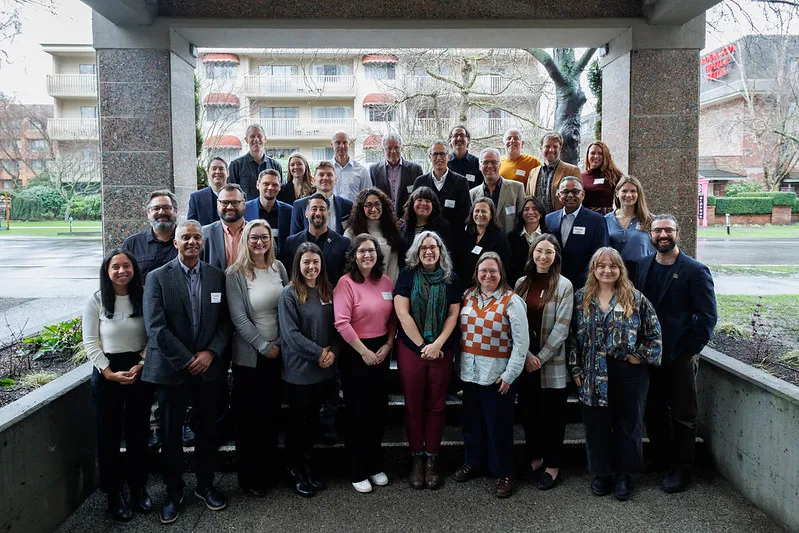
On January 12, Pembina Institute and the Accelerating Community Energy Transformation (ACET) initiative led by the University of Victoria brought together nearly 35 participants from across sectors and regions in B.C., including civil society, labour, post-secondary institutions, government, industry and Indigenous organizations.

Participants from across sectors and regions in B.C. took part in a facilitated dialogue on workforce challenges and opportunities in the clean energy transition. Photos: Geoff Howe
Our goal was to identify the issues that need deeper exploration and to surface potential solutions that could scale to support a transition to a clean economy that supports everyone in the labour market, including youth, newcomers, Indigenous and other equity-deserving groups, and mid-career workers in transition.
Several early insights emerged:
- Policy durability matters. Short political cycles and policy volatility make it harder for employers, post-secondary institutions, unions and workers to plan and invest in clean energy workforce strategy. All levels of government need to commit to stable, long-term policies and strategies that will support future education, training, and investment in clean energy jobs.
- Coordination gaps slow progress. Fragmentation across sectors and institutions limits training and career pathway alignment, particularly for youth exploring climate-aligned jobs.
- Job quality and inclusion drive retention. Safe, supportive workplaces and strong jobsite cultures are essential to attract and keep women, Indigenous people, newcomers, and other equity-deserving groups.
- Training approaches involve trade-offs. Competency-based and micro-credential programs can provide flexible upskilling, but full certification remains essential in trades and safety-sensitive roles.
- Mid-career transitions need support. Recognition of prior skills, income supports and accessible pathways help workers change fields without starting over.
- Regional access remains a constraint. Training seats, instructors and facilities are concentrated in the Lower Mainland, limiting participation for rural, northern and Indigenous communities.
- Policy tools are underused. Procurement strategies, community benefit agreements and project labour agreements could better align projects with local hiring, training and quality standard.
Recommendations from the CleanBC Review called on the B.C. government to follow through on its commitment to develop a comprehensive work force strategy for the clean energy transition. We look forward to sharing a synthesis report capturing these findings and charting next steps for this research and policy.
Strengthening a people-centred approach to B.C.’s clean energy transition will require ongoing collaboration to connect diverse perspectives and turn insights into action. We invite partners across government, labour, industry, postsecondary institutions and civil society to stay engaged as this work progresses.