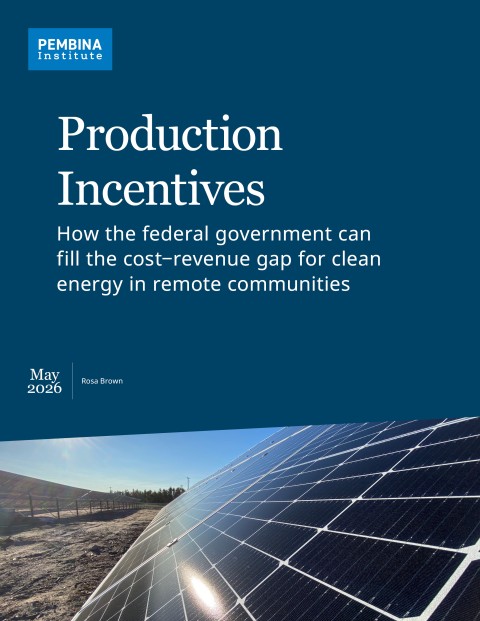
Considerable progress has been made over the past decade in advancing Indigenous-owned renewable energy projects in remote diesel communities. Despite this, independent power producers (IPPs) continue to face strong headwinds as they navigate challenging economic conditions.
This paper explores the use of production incentives - structured as a per kilowatt-hour (kWh) price adder to IPP power purchase agreements - as a tool for addressing these financial barriers, and supporting stronger financial outcomes for Indigenous and community-owned clean energy.
In the paper, we discuss:
- The economics of independent power production in remote communities
- Global examples of production-based incentives for renewable energy
- The role of the federal government in implementing and designing production incentives
We also provide policymakers with a set of recommendations and next steps for strengthening the economic and financial policy landscape for remote clean energy. These include:
- Introduce a federal, production-based PPA top-up for renewable electricity on remote diesel grids to close the revenue gap created by avoided-diesel pricing.
- Co-design the production incentive with Indigenous partners through a time-limited, Indigenous-led process.
- Redirect a portion of ongoing federal diesel subsidy spending into a dedicated, long-term renewable energy fund that finances a transparent, production-based incentive.
Maintain and replenish dedicated federal funding programs to support Indigenous‑led energy transitions in remote communities.