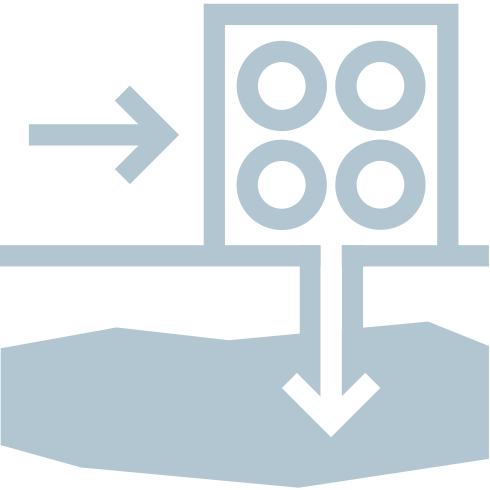

Across North America, a growing wave of data centre development is putting new pressure on electricity systems. The International Energy Agency (IEA) projects that data centres will account for nearly half of US electricity demand growth between now and 2030. These facilities are becoming critical infrastructure, supporting everything from cloud services to artificial intelligence.
But their growth comes as electricity demand is already increasing rapidly, thanks to industrial expansion, heat pumps, electric vehicles and other new technologies that are changing how homes, businesses and communities use power.
Governments and utilities are already grappling with these challenges: how much new infrastructure is needed, how to plan for it and who should pay?
In response, jurisdictions are exploring a straightforward idea: If you build a data centre, you should bring your own power.
It’s a sensible starting point. But power supply alone does not answer the equally important question of how these facilities use electricity once they are connected.
In addition to knowing how much electricity a facility will use, decision-makers must ask whether that electricity will be used efficiently and whether the grid can manage that power without adding unnecessary costs or strain.
Data centres can connect to the electricity system in different ways. Some large facilities connect directly to the high-voltage transmission grid. Other smaller centres — some built closer to cities and communities to improve the speed and performance of digital services — can connect to the same local distribution grid that serves homes, schools and businesses.
When a large new electricity user connects at the local level, it can create practical impacts. A nearby substation may need to be expanded. Local wires and equipment may need to be upgraded. Costs may rise and are often shared across customer groups. In most cases, the default response is to build more infrastructure.
But that’s not the only option.
A different approach: Bring your own flexibility
If data centres are going to be required to bring their own power, we should also ask a second question: Can they bring flexibility?
Data centres are not typical electricity users. Many can shift computing tasks to different times of day, manage cooling systems more strategically, use onsite storage or backup systems to reduce demand from the grid and lower electricity use when the system is under strain.
In practice, “bring your own flexibility” means large electricity users take responsibility not only for how they power their operations, but for how they interact with the grid.
This distinction matters. A data centre may be powered by lower-emission electricity and still create new costs for the system if it drives peak demand in an area where local infrastructure is already constrained. It may still trigger upgrades to costly infrastructure and add pressure when the grid is stretched.
With the right structures in place, those same facilities can help do the opposite: reduce demand during critical periods, avoid or defer costly upgrades, support reliability and create more value from the infrastructure already in place.
The technologies already exist. Data centres can invest in high-efficiency equipment, manage cooling demand, use batteries or backup systems strategically and shift some electricity use away from constrained periods. Often missing are the planning processes, utility programs and load management approaches that make this flexibility visible, valuable and usable on the local grid.
Designing for what comes next
For decades, electricity systems have been built around the assumption that supply adjusts, while demand is treated as fixed.
That model is outdated.
Flexibility should be considered before infrastructure decisions are locked in. Utilities should assess whether flexible demand can help avoid or delay upgrades. Policymakers and regulators should ensure the rules enable that flexibility.
These are practical steps. They do not require decision-makers to choose between economic growth and affordability, or new digital infrastructure and a reliable grid. Data centre growth can support both, but achieving that balance requires electricity planning, utility programs that support flexibility and grid connection processes to consider more than power supply.
A more complete conversation
Data centres are not going away. The question is not to support them, but how?
“Bring your own power” is part of the answer.
But if we want electricity systems that are affordable, reliable and ready for growth, large electricity users need to be treated not only as new demand but as a source of flexibility.
Today, even when flexibility is technically possible, it is rarely enabled or used at the local level where it could have the greatest impact.
We need to design our systems for better outcomes — not just power, but flexibility.