
CALGARY — CHRIS SEVERSON-BAKER, the Pembina Institute’s executive director, made the following statement in response to the release of the International Energy Agency’s 2026 World Energy Outlook:
“As countries around the world race for secure and affordable energy – driven by the most significant energy shock in modern history – this report shows the winning path is toward clean energy and electrification. The volatility of global fossil fuel markets has never been clearer, or more expensive – and importers are learning they can cut reliance drastically by prioritizing renewables, electrification, and energy efficiency. As IEA Executive Director Fatih Birol said, “I don’t see any credible pathway for the energy world to return to the way it was before… encouragingly for the future, energy security and energy transitions have never been so closely aligned.”
“Across all scenarios, demand for electricity grows fast – reaching 30% electrification by 2035. Meanwhile, global fossil fuel investment stagnates or declines by 2035 in three of four scenarios – and in the most probable scenario, oil demand peaks by 2030. Canada’s plans to double its power grid and increase the electrification of its economy by 2050 aligns with these global trends. Plans to build new taxpayer-funded oil pipelines and rely heavily on taxpayer-supported LNG exports, however, deserve scrutiny.
“The Current Policy Scenario (CPS) presents a Trumpian vision of the future where the energy transition stalls and fossil fuels dominate continually. The Stated Policy Scenario, meanwhile, shows a future better aligned with avoiding catastrophic climate change. Regardless of the scenario, energy security means reducing reliance on fossil fuels.
“In all scenarios, EV uptakes continue to rise but fastest in China and the EU, proving this shift is here to stay. Canada is in real danger of falling behind – that means consumers miss affordability gains and our manufacturing sector is increasingly decoupled from the global market threatening jobs. Higher energy efficiency (or in turn lower energy intensity of GDP) means more work done for fewer resources. This contributes to affordability and reduces risk to energy price shocks.
“As Canada looks to diversify trade partners and position itself as a leading middle power, leaning into our strengths as a clean energy superpower – including leadership on emerging transitioned-aligned industries like critical minerals – must be central. This is what middle-power leadership on energy and climate looks like.”
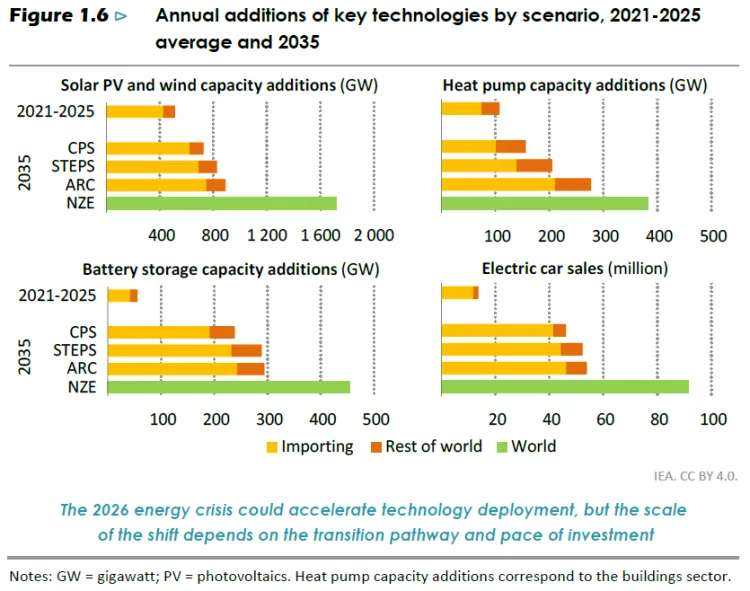
Figure: International Energy Agency World Energy Outlook 2026. Caption: The 2026 energy crisis could accelerate technology deployment, but the scale of the shift depends on the transition pathway and pace of investment.
Quick facts
- For the first time in history, more energy is required to cool buildings than to heat them.
- The widely agreed upon overshoot of 1.5 °C warming above pre-industrial levels can be directly attributed to human-caused climate change due to burning fossil fuels.
- Many countries have turned to electrification as a strategic response to events in 2026: 25 have announced new electrification-related policies since February.
- The available data for 2026 suggest that the oil and gas supply shock is accelerating solar PV, battery and EV adoption in many countries, compared with the same period in 2025.
- Electricity today accounts for around 23% of final energy consumption, but it is the key source of energy for sectors accounting for over 45% of the global economy.