CALGARY — New analysis from the Pembina Institute shows community-led clean energy projects have displaced over 140 million litres of diesel in remote communities in Canada since 2016 – more diesel than all three territories use to generate electricity in an entire year.
Diesel Reduction Progress II provides Canada’s most up-to-date cumulative analysis on remote diesel consumption and clean energy development since 2020. According to the report, significant gains in diesel reduction and clean energy development have been achieved through effective government programs and policy, alongside local Indigenous leadership.
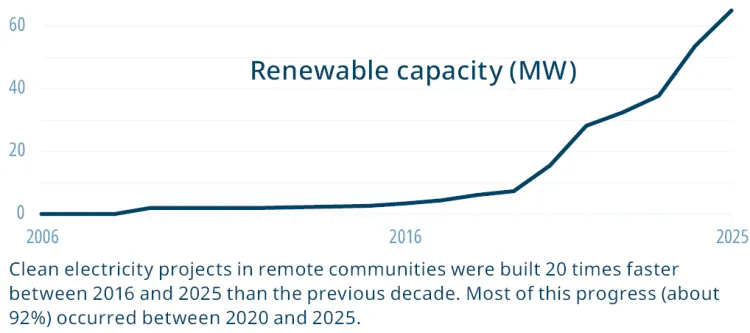
Clean energy development in remote communities has grown significantly in the last decade, highlighting growing role of renewables in remote areas
From 2016 to 2025, hundreds of renewable energy projects — all of which are generating power for an array of buildings, homes, and microgrids — have been installed in nearly half of all remote communities in Canada. The rate of development represents a remarkable step forward for remote communities, many of which have relied heavily and solely on diesel generators for heat and electricity since the 1950s.
Federal policy, local leadership set foundation for significant gains
The national report underscores the fundamental role both federal policy and local Indigenous leadership have played in advancing shared goals for improved energy systems.
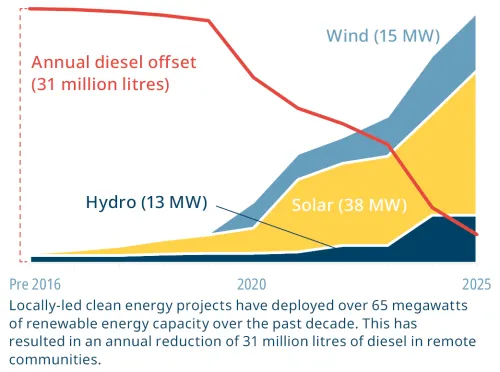
Since 2016, key federal programs (including the Clean Energy for Rural and Remote Communities Program and Northern REACHE, among others) have removed major barriers to local clean energy action through capacity building, funding, and local job creation. With the support of these programs, community-led clean energy projects are now displacing more than 31 million litres of diesel per year in remote communities.
Notably, the report shows significant rates of diesel reduction starting in 2018, when key federal programs began supporting community clean energy project development, unlocking a half a decade of significant progress.
The challenge ahead: responding to growing demand
The report shows that in 2023 — the most recent date for which consumption data are available — diesel used for heat and electricity in remote communities exceeded 740 million litres, up from 705 million litres in 2016.
This rising consumption is directly due to a continued increase in demand, especially in the territories where remote population sizes have steadily grown since 2011.
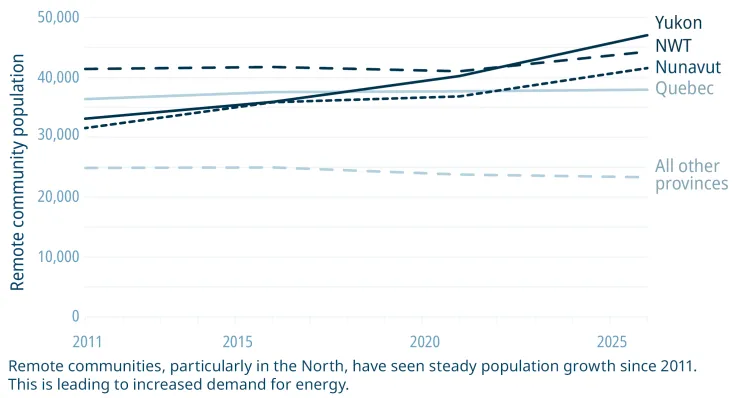
The report urges swift action on the part of federal and territorial governments to invest in modern and diversified remote energy systems that can effectively respond to rising demand.
Complex energy systems require robust, continued and coordinated action
Taken together, the data in this report reinforce the growing role renewables play in modernizing and diversifying local clean energy systems — an increasing necessity as communities are exposed to volatile and rising fuel costs, deteriorating infrastructure, and increasing demand for energy.
As economic pressures grow and as demand increases, this research makes the strong case that now is not the time to slow down, but the time to build on what’s already working.
Quotes
“Remote communities are in the midst of their most significant energy transition since the introduction of diesel generators in the mid-twentieth century. Building on this progress requires continued focus and collaboration with local leaders and First Nations, Inuit, and Métis governments — especially as all levels of government grapple with the intersecting challenges of arctic security, economic resilience, and climate change.”
— Arthur Bledsoe, Senior Analyst, Pembina Institute
Quick facts
- Clean electricity projects in remote communities grew 20 times faster between 2016 and 2026 than the previous decade, with most of this progress (about 92%) occurring between 2020 and 2025.
- Since 2016, community-led renewable energy projects in remote communities have displaced over 142 million litres of diesel, more diesel than all three territories use to generate electricity in an entire year.
- Grid connection projects have substantially reduced diesel use for electricity, with recent grid connections in Quebec and Ontario reducing diesel consumption by nearly 22 million litres annually.
- 72% of the community-scale clean electricity projects operating in remote communities are wholly or majority Indigenous-owned.
- Remote consumers pay 6−10 times more for energy than the rest of Canada. Canadian governments spend upwards of $300 million a year on diesel subsidies alone.
- Canada is home to more than 210 communities that are not connected to the North American electrical grid. The vast majority of these communities are Indigenous.
[30]
Contact
Bhan Gatkuoth
Senior Communications Lead, Pembina Institute
587-742-0818
Background
Report: Restoring the flow
Report: Diesel reduction progress I
Backgrounder: Diesel subsidies in remote communities
Op-Ed: Local progress on energy, Arctic security must survive federal cuts
Blog: The clean energy transition in remote communities