Carbon dioxide removal (CDR) is a necessary part of the climate response, but its value can't be measured solely by tonnes of CO2. Deploying CDR at scale has ripple effects well beyond the climate system, and understanding those effects is essential to getting CDR right.
There is an urgent need to understand whether growing reliance on carbon removal could delay or weaken near-term emission reductions across sectors such as transportation, industry, and oil and gas production. This question is particularly important in Canada, where many emissions-intensive sectors are also major sources of air pollution, and where pollution burdens are unevenly distributed across communities.
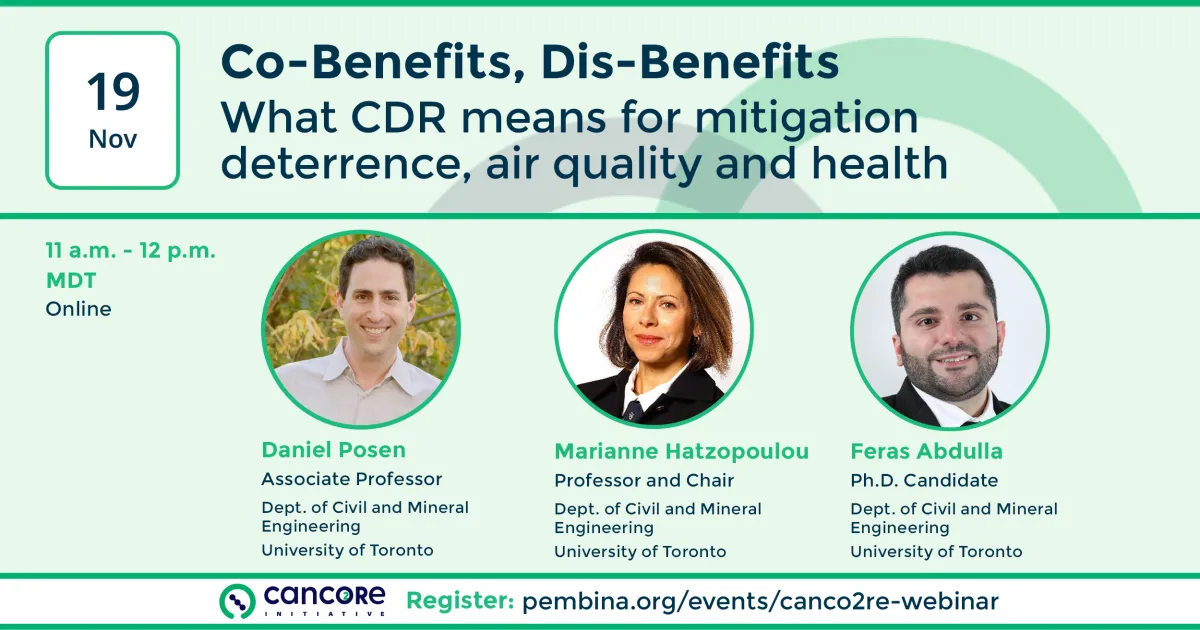
This webinar examines CDR through systems, societal, and air quality lenses, characterizing how and where CDR might enable mitigation deterrence, and how these pathways can consequently alter co-pollutant emissions, population exposures, and health outcomes.
Two CanCO2Re researchers, Daniel Posen and Feras Abdulla, collaborating with an air quality expert, Marianne Hatzopoulou, will examine how CDR affects air quality to identify optimal deployment strategies that deliver climate benefits without undermining public health.
Join us to unpack the co-benefits and dis-benefits of different CDR pathways: where CDR strengthens mitigation efforts, where it can work against them, and what “doing CDR well” looks like.
About CanCO2Re
This session is part of the CanCO2Re webinar series, which brings together experts from across disciplines to advance Canada's understanding of carbon dioxide removal. The series is a program of the CanCO2Re initiative, a national research effort that connects researchers across 11 fields of study, from engineering and climate science to law, economics, and communications, through institutions including the University of Calgary, University of Alberta, University of Toronto, Simon Fraser University, and the Pembina Institute.