Pembina Channels:             |    Print    |    Send    |    Resize: A A A
 

Pembina Institute


When it comes to enforcing its regulations, is the ERCB more bark than bite?

When the Energy Resources Conservation Board (ERCB) rolled out new regulations to manage oilsands tailings production (Directive 074) in February 2009, my colleagues and I were hopeful that a new, tougher approach to regulating oilsands development had begun. But based on past experience, we were cautiously optimistic at best.

At the time, my colleague Jennifer Grant responded: "Given the very weak track record of the ERCB and the Government of Alberta in implementing and enforcing oilsands environmental regulations, it may take two to five years to determine if this directive has teeth."
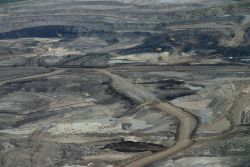
Tailings lake in northern AlbertaBut to our pleasant surprise, as deficient tailings (a toxic liquid byproduct of oilsands production) management plans started piling up (our review with Water Matters found seven of nine plans failed to meet the regulations), the ERCB continued to talk tough. 

An ERCB spokesperson, told the Fort McMurray Today the new rules would have more "teeth" and specifics than past rules, and went on to predict that within the next two years, the board would be able to look at targets outlined by companies. If anyone falls short, the regulator would step in and take enforcement action, ranging from increased audits and inspections to shutting an operation down. The spokesperson said, "That gives you a lot of power to get things done." 

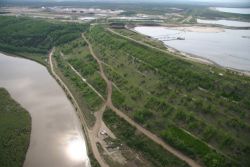
In another interview with Dan Healing, a reporter with the Calgary Herald (for a story later picked up by other PostMedia Network newspapers), an ERCB representative asserted: "The directive was passed last February after pretty extensive consultation. ... We went over it to see if there were any deal-breakers, anything that the companies would be unable to comply with, so the final directive was something the companies would be able to comply with."Suncor's Tar Island tailings dam (next to the Athabasca River)
An ERCB spokesperson also told Global News, "... all projects will meet the ERCB tailings standards if they want to operate in Alberta." 

To the Edmonton Journal, an ERCB representative said the regulator prides itself on rules that are fair, achievable and enforceable, and went on to say, "This is the first time in the history of the oilsands that companies have had to meet this kind of a requirement. We are trying to work with them, but at the end of the day those standards will have to be met."

In another story, the ERCB continued singing the same tune stating, "Companies are expected to be compliant with the regulations as they stand now. And if they are not compliant they won't be approved." 

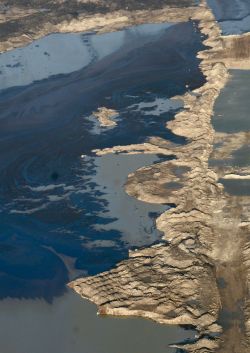
With all the tough talk, we remained hopeful. And Suncor's October 2009 commitment helped us stay that way for a while. The oilsands operator committed to a nTailings lake in northern Albertaew approach to tailings management that would comply with the new regulations — a clear signal that the industry had the technological and financial capacity to step up and begin addressing their toxic tailings.
My colleague Simon Dyer stated at the time, "Suncor's proposal raises the bar for all companies operating in the oil sands, and it is essential that other oilsands companies are required to meet the new rules to deal with toxic tailings waste." 

But by April of this year, after months of behind-closed-doors negotiations with oilsands companies, the ERCB did a 180 degree spin from its tough talk of 2009 by approving Syncrude's non-compliant tailings management plans.

That's right, the regulator approved a plan by a company that clearly stated it would not meet the regulations. Even more ironic was the fact that this about face came the day after Alberta Premier Ed Stelmach used Earth Day to declare that his government would force an end to oilsands tailings ponds.Premier Ed Stelmach, Photo courtesy Government of Alberta

ERCB spokespeople have now started talking about taking a "collaborative" approach with industry, suggesting that it's "reasonable" to give companies who aren't meeting the regulations some flexibility. Indeed, on the ERCB's approval of Syncrude's plans, one spokesperson told CTV that Syncrude "might not have been satisfying the letter of the Directive until 2014 but they were certainly obeying the spirit of it."

In August, the ERCB approved Imperial Oil's tailings management plan, which also fails to meet the regulations. Astonishingly, a supposed state-of-the-art oilsands mine, just approved in 2007, is unable to meet basic clean up rules for another eight years — something doesn't add up.Syncrude oilsands operation in northern Alberta

Once again, we find ourselves commenting about weak implementation and government regulators who seem to lack the willpower to enforce their own regulations.

So this week on behalf of the Pembina Institute and Water Matters, Ecojustice filed an application with the ERCB requesting approval of Syncrude's non-compliant tailings management plans be withdrawn until they are brought in line with the ERCB's tailings management directive. By our estimation, the ERCB doesn't have the legal authority to approve plans that are not in compliance with the directive.

Stay tuned for the outcome.

Learn more about Pembina's Work in Alberta.

Read more blogs relating to Oilsands, Alberta, Provincial Action, Water.

eyeswideopen — Aug 31, 2010 - 07:31 PM MT

is it just me or does anyone else think that if a study was conducted and found that the oilsands are NOT meeting Federal or Provincial regulations, that work should be halted ASAP. If people are geting sicker by the day that our goverment would want to protect us and STOP the reason for us getting sick.........FOOD FOR THOUGHT.

John Sobkowicz — Aug 27, 2010 - 09:52 AM MT

This article contains inaccurate statements that unfortunately lead the author to an erroneous conclusion.

First, the ERCB did NOT carry out extensive discussions with the industry prior to implementing Directive 074. While they held discussions and listened to industry comments, the final Directive was essentially unchanged from the initial draft Directive. The very valid concerns of the industry were not sufficiently considered nor incorporated into the Directive.

The result is that the ERCB did not, and still does not, fully understand the impact of the Directive on the oilsand operators. The directive requires significant to large (depending on the mine site) changes in already approved tailings plans. Changing these plans takes time and a lot of money - it cannot be done with a snap of the fingers.

An analogy might illustrate this - if your daughter informed you a week before an elaborate and costly wedding, one that was already planned, agreed to and mostly paid for, that she absolutely had to move the date forward by two days, and if that change would double or triple the cost of the wedding, how would you feel? Further, if the reason for changing the date was that she could hold it in the much nicer Venue B than the original Venue A, and if upon further examination and consideration, you realized Venue B was available for the same price 2 days AFTER the planned wedding, what date would you be pushing for?

That is the reason there is a need for flexibility in implementing the Directive at each mine site. Note that the ERCB is also tasked with making sure the operators economically recover oil from the oilsands. The ERCB needs to balance these two and several other objectives at the same time, which they are now very rightly trying to do.

Secondly, the Directive could be significantly improved with little effort - currently, it is too prescriptive instead of being performance-based. It focuses too much on short term technical goal posts and not sufficiently on long term performance, which is the real issue. The concept of measuring and reporting progress is a solid component of holding the oilsands operators accountable for what they say will do - I applaud that part of the Directive. But I believe the Directive objectives can be met in less costly and disruptive ways, while still tightly holding the operators accountable for delivering reclaimable landscapes.

I am presenting a keynote paper at the 2010 Tailings and Mine Waste conference in Vail, Colorado (October 17-20), in which there is a full section (4 pages) of discussion on the impacts of Directive 074 (and on how the Directive can be improved). I invite you to read this paper ("History and Developments in the Treatment of Oilsands Fine Tailings") when it is published to obtain a balanced and more informed view of the Directive's pros and cons, and on the oilsand industry's efforts, over the years, to find solutions to the very challenging problem of cost-effectively dewatering oilsand fine tailings.

The Pembina Institute's interest in watching how the ERCB implements Directive 074 is understandable - many of us are giving equal diligence to this issue, and for similar reasons. But your conclusion that the Directive lacks teeth and, by implication, that it will not be effective, is incorrect. It seems to me that your opinion is based on a poor understanding of the underlying issues, on inaccurate information and on faulty logic. So too is the Institute's application to the ERCB to withdraw their approval of Syncrude's tailings management plans.

You would better serve the general public and your own followers by being more well-informed about the issues. You are only going to get this information if you enter into some open-minded and unbiased discussion with the industry, which I think you would find they would be quite willing to do.

Dan Woynillowicz — Aug 31, 2010 - 12:26 PM MT

Hi John,

Thanks for taking the time to share your perspective on the ERCB's Directive 74. You raise some important considerations, but also make some statements that are worthy of a response.

First, regarding your suggestion that the ERCB did not carry out extensive consultations with industry, I'm afraid that I simply have access to publicly available information about the nature of this consultation.

On the one hand, we have representatives from the ERCB publicly stating that they consulted extensively with the industry. The ERCB notes that it engaged the industry in a technical review of the draft Directive in May 2008 and published the feedback it received. It also convened public and industry workshops in September 2008, and similarly published the input and feedback. The ERCB summarized its consultation efforts in a FAQ on tailings, posted to its website:

"The draft tailings directive was released on June 26, 2008, to the public and industry. Input was requested by September 15, 2008. In April 2008, prior to the formal release of the draft directive, the ERCB also consulted with the Canadian Association of Petroleum Producers (CAPP) and individual oilsands operators. In August, CAPP requested an industry workshop to gain clarity regarding various elements of the directive. The ERCB conducted two workshops. The first was held on September 9, 2008. ERCB, Alberta Environment (AENV), Alberta Sustainable Resource Development (SRD), and the Department of Energy (DOE) staff met with representatives of industry to discuss project-specific concerns and technical issues.

The second workshop was held on September 24, 2008, to collect information and hear concerns. Attendees included interested First Nations, ERCB, AENV, SRD and DOE staff, and industry representatives. The draft directive was also posted to the ERCB Web site. Letters on the directive were received from individuals and industry. The notes from the workshops, assessments of workshop input and letters, and the public workshop presentation are posted on the ERCB Web site. One-on-one meetings with the ERCB are still available upon request."

On the other hand, you claim that the consultation was not extensive. I concede that this could be substantiated by the fact that the majority of tailings plans approved by the ERCB so far are not compliant with the Directive. Clearly something is amiss.

But your point about the extent of consultation raises another issue, which you also touch upon explicitly by asserting that "...the ERCB did not, and still does not, fully understand the impact of the Directive on the oilsand operators."  If it is the case that the ERCB lacks this technical capabity, it is certainly troubling to consider this scenario in which a regulatory agency, entrusted with managing energy resource development in the public interest, is ill-equipped to effectively develop and implement regulations. This potentially reflects a much deeper problem with the management of energy development, including oilsands, in Alberta and I look forward to exploring it in more detail.

The remainder of your criticism, both of the Pembina Institute's perspective and the Directive itself, are premised upon your technical assessment of the tailings issue and opinion about the type of policies (prescriptive or performance-based) that would be the appropriate regulatory response.

The basis of the blog post's criticism of the ERCB's implementation of the Directive, and the Pembina Institute and Water Matter's request for the ERCB to withdraw its approval of Syncrude's non-compliant tailings plan, are premised upon the effectiveness of the ERCB's implementation of the regulations, without taking a position on the merits of the Directive itself from either a technical or policy perspective.

The basis for effective regulation is consistent and fair application of the regulation, monitoring and enforcement. In this instance, to the extent that flexibility from one oilsands project to the next is necessary (and there are a range of perspective on this point), this should have been factored into the development of the Directive a priori. Failing this, we end up with the current scenario in which this "flexibility" is granted through inconsistent application of the regulation and associated enforcement, which undermines both the validity of the regulation itself (and its purpose) and the credibility of the regulator. From the outset, the ERCB was clear that "This Directive will set firm requirements for oilsands operators to manage their tailings – and meet those requirements – or face enforcement action."

I would suggest it is likely that your technical concerns with the ERCB Directive and our concerns with the ERCB's implementation of the Directive are equally valid, and are representative of the persistent challenge of managing and regulating a complex, costly and rapidly expanding sector -- a challenge that lies at the root of much public concern regarding how to ensure that oilsands development occurs in a responsible manner.

I look forward to reviewing your upcoming paper and perhaps returning to this topic in a future blog post.

John Sobkowicz — Sep 08, 2010 - 10:31 PM MT

Dan - thank you for your comments and desire to lay out your arguments in a clearer fashion.

In regards to your response to my posting on this issue - despite whatever "publicly available information" that you have, my statement that the ERCB did not carry out extensive consultations on the Directive is the straight goods. Did you ask any of the oilsand operators what they thought about the consultation process? The ERCB may have talked to them, but they certainly did not listen. The "consultations" were very controlled and one-sided - not a good way to run a public consultation process.

And a point of clarification - I did not say that the ERCB lacks technical capability - I said I don't think that they fully understand the tailings storage issue and challenges (and I should add, "yet"). The lack of understanding arises because the issues are technically complex and difficult to fully grasp unless you have first-hand knowledge of the industry and/or listen very carefully.

My comments about the ERCB relate to the extent to which they have listened and really tried to grasp the complexities of the points the operators are making (not to their technical capabilities, which are certainly equal to the task). The same criticism could be applied equally to some of the comments I have seen from the Pembina Institute - they are based on incomplete information and therefore lack real insight into the issues. I point this out because I believe stakeholders like the Pembina Institute could be and need to be more diligent about understanding the technical issues, if they wish to be of real service to their readers. What is called for is more informed and reasoned dialogue, and less rhetoric.

S. McKechnie — Aug 27, 2010 - 09:25 AM MT

Investors and Industry need to be accountable for the long term. Equitable shares would remain invested in the “development” until after restoration of the land is complete. Rather than investing $100.00 expecting a return over a specific time, know that the investment is there from beginning to end, and expect to pay or profit depending on the accuracy of the original estimates. All required funds in place before work begins.

Regulator — Aug 26, 2010 - 10:33 PM MT

Here's a little secret: the ercb is hamstrung by the regs more than most people realize. Imagine being a parent with the ability to make the house rules, but with no stick or enforcement ability. Read any decision report and note how many times the ercb will make a reccomendation that Alberta Environment does x, y or z. It's like the ercb is the mom and aenv is the dad, and the ercb is telling the kids to wait until their father gets home. Without any ability to enforce, the ercb can only make reccomendations that aenv follow up on a matter. The ercb might have power to actually enforce if it were granted jurisdiction to do so. It is a creature of the province, and the province has designed the red tape circus to be dysfunctional by design.

J Allan — Aug 25, 2010 - 11:22 PM MT

maybe government regulation does not work, and we need to move to "full-cost accounting" -- taxing the oilsands industry for air, water and land deterioration; with the costs added on to the cost of the product, and let the market motivate the environmental catch-up.

Post new comment

We will not publish or share your email address.
CAPTCHA
In an effort to reduce spam abuse, we ask that you type the characters that you see below.
Image CAPTCHA
Enter the characters shown in the image.