
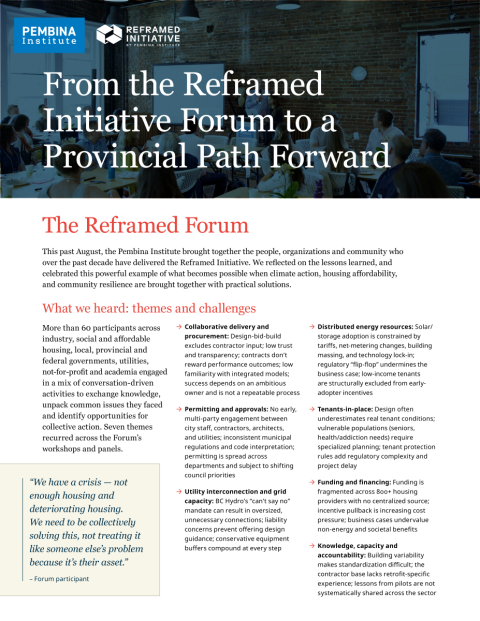
After nearly a decade of collaboration, innovation and learning, the Pembina Institute reconnected leaders and participants from across British Columbia's housing, utility, construction, finance and policy sectors to reflect on what is working and how we will drive change to scale building retrofits.
Our message came through clearly: the solutions exist. From collaborative procurement and tenant-centred design to financing, permitting and utility reform, we know the barriers standing in the way of faster, deeper retrofits, and we know what it will take to overcome them. We know the barriers slowing progress, including complex processes, capacity constraints, misaligned financing models, limited tenant engagement and fragmented workforce silos, and we know what it will take to overcome them and scale faster, deeper retrofits across the sector.
The Reframed Initiative has spent close to a decade demonstrating how whole-building retrofits can improve affordability and resilience, and create healthier homes for residents while reducing emissions from heating and cooling mechanical equipment. Through six social and affordable housing retrofit projects in British Columbia, the Initiative has generated practical lessons, tested innovative approaches and built a network of organizations committed to transforming how retrofits are delivered.
What did forum participants identify as the key lessons for scaling retrofits in B.C.?
- Collaboration is critical. Reframed helped build trusted relationships and a shared vocabulary across a historically fragmented retrofit ecosystem.
- Tenant-centred retrofits are achievable. Pilot projects demonstrated the value of early tenant engagement, thoughtful relocation planning and approaches that minimize disruption for residents.
- Better procurement improves outcomes. Collaborative delivery models consistently outperformed traditional design-bid-build approaches by aligning project teams around performance, quality and long-term value.
- Innovation can be deployed today. The Initiative successfully tested approaches such as prefabrication, panelization and advanced heat pump technologies in affordable housing settings, while also identifying a common barrier to wider adoption: procurement and project delivery processes that can limit collaboration across the retrofit ecosystem. Modernizing these processes will be critical to unlocking innovation and delivering retrofits at scale.
- Policy barriers remain. Inconsistent permitting, utility interconnection challenges and fragmented financing continue to slow retrofit deployment at scale.
- The Forum reinforced that the challenge is no longer proving whether deep retrofits work. The challenge is creating the conditions that make them commonplace.
What's next?
To move from successful pilot projects to a province-wide retrofit ecosystem, participants identified seven priorities:
- Enable collaborative retrofit delivery.
- Streamline permitting and approvals.
- Right-size utility connections.
- Strengthen tenant-centred retrofit planning.
- Stabilize long-term retrofit financing.
- De-risk clean technology adoption.
- Institutionalize knowledge-sharing and workforce development.
Together, these actions can help scale retrofits so that they are faster, more affordable and easier to deliver, while improving housing outcomes and supporting a more resilient energy system.
Explore the roadmap
The Reframed Initiative has helped answer an important question: Can deep retrofits be delivered at scale in affordable housing? The answer is yes.
Now, the focus shifts to how governments, housing providers, utilities and industry can accelerate adoption across British Columbia and Canada.
Explore our roadmap to learn how proven retrofit solutions can support affordable housing, strengthen energy systems and build a more resilient, low-carbon future.