

Industrial expansion, data centres, population growth and electrification are putting new pressure on a system already facing affordability, reliability and infrastructure challenges. Much of the public conversation focuses on how much new electricity Alberta will need and how quickly the grid can expand to deliver it.
But Alberta has another resource that remains largely untapped: electricity demand itself.
Demand-side management, or DSM, is the planned use of customer-side resources to reduce electricity consumption, shift demand away from peak periods and improve electricity system efficiency. It includes:
- energy efficiency, which lowers the amount of electricity needed to deliver the same service
- demand response and load management provides flexibility by reducing or shifting load during peak periods or system stress
- local distributed energy resources such as batteries, electric vehicles, rooftop solar and smart controls that can be aggregated to support local grid needs.
In modern utility systems, DSM is planned and integrated into the system as one more tool, along with utility-scale generation and transmission expansion, to meet growing system needs while maintaining affordability.
DSM gives utilities more options before new infrastructure becomes the default answer. Together, these resources can reduce the size, timing and cost of future electricity investments.
Other jurisdictions already treat DSM as a system resource
Wisconsin, Ontario, and Texas have all built formal DSM frameworks to reduce consumption, manage peaks, improve reliability and avoid unnecessary system costs.
The results are measurable and significant enough to understand in everyday terms.
Wisconsin
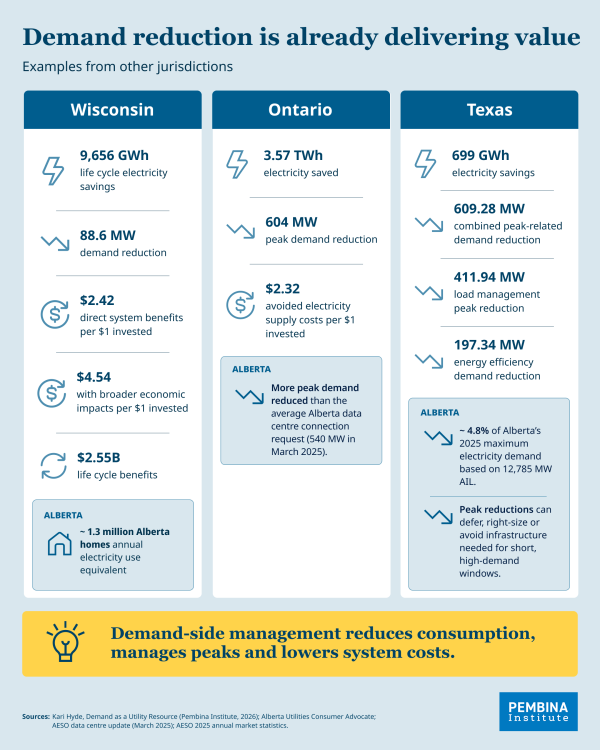
Wisconsin’s Focus on Energy program:
- generated approximately $2.55 billion in life-cycle benefits from 2019 to 2022
- delivered 88.6 megawatts of demand reduction and 9,656 gigawatt-hours of life-cycle electricity savings
That electricity savings is roughly equivalent to the annual electricity use of more than 1.3 million Alberta homes. (The average Alberta home uses approximately 600 kWh of electricity per month). Every dollar invested returned $2.42 in direct electricity system benefits, or $4.54 when broader economic impacts were included.
Ontario
Ontario’s conservation programs show the same pattern: reduced electricity use, reduced peak demand and avoided system costs. Under the 2021–2024 framework, Ontario:
- saved around 3.57 terawatt-hours of electricity
- lowered peak demand by 604 megawatts.
To put that in context, the average Alberta data centre connection request was 540 megawatts in March 2025. Ontario’s conservation programs reduced more peak demand than that average request, while returning about $2.32 in avoided electricity supply costs for every dollar invested.
Texas
In 2024:
- Texas energy efficiency programs reduced peak demand by 197.34 megawatts and saved 699 gigawatt-hours of electricity.
- Load management programs reduced peak demand by another 411.94 megawatts.
Combined, that is more than 600 megawatts of peak-related demand reduction — roughly equivalent to shaving nearly five per cent off Alberta’s 2025 maximum electricity demand (12,785 MW).
Peak demand reduction is important because electricity systems are often built to serve short windows of very high demand. If those peaks can be reduced or managed, utilities can defer, right-size or avoid infrastructure that would otherwise be needed for only a limited number of hours.
Alberta needs access to the full demand-side toolkit
Energy efficiency reduces the baseline demand the system has to serve. Load management and demand response help manage the shorter, sharper peaks that can drive costly infrastructure decisions. Alberta needs both durable reductions that lower overall system pressure and flexible tools that can respond when demand is highest.
Demand response pilots are already emerging in Alberta. They can test customer participation, dispatch, measurement and local system value. But Alberta should not build its regulatory framework around demand response alone. A one-tool framework will not solve a multi-tool problem.
Utilities need access to the full demand-side toolkit: energy efficiency, demand response, managed charging, battery storage, energy resource aggregation and non-wires solutions. In some cases, the right approach to provide savings to ratepayers, may be a targeted demand response program or building retrofits that permanently lower demand. Often, a utility will need a portfolio of solutions working together. The framework should allow utilities to combine these tools where they are more cost-effective than traditional infrastructure.
The framework should also make it possible for utilities or program administrators to invest in DSM portfolios, recover costs, procure third-party resources, measure results and be compensated in ways that align with customer and system benefits. Distribution utilities have raised the potential role of DSM through rate applications for more than a decade, with limited success. The issue is not whether DSM has value; it is that the Government of Alberta has yet to build the pathway utilities and industry needs to deliver savings.
DSM requires clear authority, dedicated investment, cost recovery, regulatory oversight, cost-effectiveness testing and independent evaluation. These are not administrative details. They are the foundation that turns demand reduction from a good idea into a reliable utility resource.
Alberta will still need new electricity infrastructure. But every kilowatt of demand that can be avoided, reduced or shifted today is one less kilowatt the system has to generate, deliver and pay for in the future.
It is time to move from direction to delivery
In October 2025, DSM was included in the mandate letter for Alberta’s Minister of Affordability and Utilities. It’s now time for that direction to become a working framework. Alberta can no longer afford to spend another year treating demand-side resources as a future conversation while other jurisdictions use them to optimize utility assets, defer or avoid infrastructure where cost-effective, and give customers more ways to manage electricity use and costs.
The province has spent years planning around supply. It is time to build the rules that allow demand to play its part.