
This summer, the Government of Canada launched its National Strategy for an Electrified Canadian Economy, highlighting the need to double Canada’s electricity capacity and accelerate electrification over the next two decades. The Government of Alberta is also taking steps to grow the provincial electricity system.
But one of the fastest and lowest-cost approaches to improving affordability, energy security, and economic resilience is being overlooked: improving energy productivity in buildings through retrofits.
Scaling retrofits depends on having the materials, components, and workforce in place to meet anticipated demand. Our recent report, Resilient but Not Ready, finds that Alberta’s retrofit supply chain is adaptable and positioned for growth. Yet without coordinated action on affordability, trade resilience, workforce development, and long-term market signals, the province risks missing a major economic opportunity. Strengthening Alberta’s retrofit supply chain today will also help prepare the province for a more electrified economy by helping to reduce building energy demand loads, easing pressure on the grid, and ensuring the workforce and supply chains needed to deliver building retrofits are in place.
Based on industry engagement, market analysis, and supplier surveys, our research shows that workforce and skills gaps, along with the absence of a coordinated sector roadmap, continue to hold the retrofit market back.
What is the potential ROI of retrofits in Alberta?
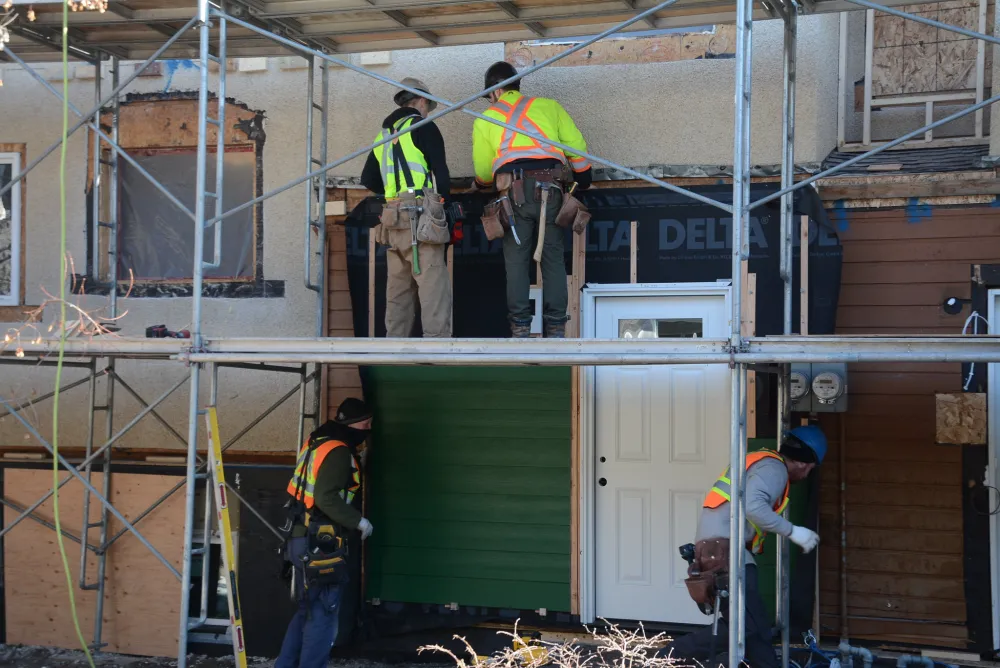
Retrofits are a no regrets solution. By boosting the efficiency of energy use in our buildings, we save money on utilities, ease grid demand, and harden our buildings against damage from hail, wind, flooding and fires. Our research shows an annual investment of $2.5 billion in Alberta would return $5.8 billion in GDP per year and sustain 24,000 jobs. If Albertans want to reap these rewards, industry, government and utilities must each take steps forward.
Alberta’s building retrofit supply chain shows resilience but needs support to expand
Our conversations across the retrofit supply chain — equipment manufacturers and distributors, building design and engineering, and the contractors and trades that retrofit and maintain buildings — were bound to discuss trade volatility and the Canada-U.S. trade war. What surprised us, however, was the adaptability expressed by supply chain actors. While many have been impacted by these latest disruptions the lessons learned through past disruptions, for example the recent pandemic, minimized the impact of recent trade volatility. As a short-term strategy, supply chain actors have learned to pivot to new distributors, or even to deal directly with the manufacturer, to ensure delivery of specific projects. This is a positive insight into Alberta’s retrofit supply chain, telling us that existing market actors are resilient. However, market analyses also anticipate challenges to sector and workforce capacity and capabilities on the horizon.
Workforce occupational and skill gaps are emerging and expected to grow
Research by SAIT, WSP, and the Delphi Group highlight the expected occupational and skill gaps in Alberta’s retrofit sector. Skilled labourers are retiring at rates faster than recruitment, leaving both a gap in workforce resources and the skills needed in the retrofit sector. Development of a diverse and inclusive workforce also continues to be an issue. Women only make up eight per cent of the on-site construction industry workforce. Two-thirds of the women employed in the trades in general are off-site, primarily in administrative and management positions.
To offset these workforce challenges, Alberta will need to work toward recruiting approximately 25,000 workers by 2030. However, there remains a looming skills gap, particularly in technologies such as advanced HVAC systems, building automation, energy modelling, and renewable energy integration.
How can clarity on the scope and pace of retrofits in Alberta lead to market readiness?
Improving energy use in commercial and residential buildings is essential to keep utility costs affordable while meeting the growing demand for electricity in Alberta, and across Canada. Supply chain actors we engaged are clear: the building retrofit sector can contribute, and it needs predictable market signals to expand and strengthen retrofit supply chains.
This research reinforces previous work — government leadership is critical.
Industrial strategies, or roadmaps, send clear policy signals, helping drive predictable and stable demand for building retrofits and high-performance products and equipment. A coordinated market development roadmap for building retrofits creates the demand needed to unlock investment by manufacturers, builders, contractors, building owners, utilities, and other stakeholders.
A business-as-usual approach will not address the workforce, supply chain, and market barriers holding back Alberta’s retrofit sector. As a result, the province risks missing a major opportunity to lower utility bills, strengthen resilience to extreme weather, and support economic growth. Just as Canada and Alberta work to build the electricity system needed for an electrified economy, Alberta must also strengthen the retrofit supply chain that can help reduce demand growth and ease pressure on the grid.
To meet this moment, government, utilities, and industry should work together to develop a coordinated market roadmap for building retrofits, including pathways to strengthen supply chains and recruit more workers.
To learn more about the research behind this blog please check out our full report https://www.pembina.org/pub/resilient-not-ready.
The Pembina Institute acknowledges the generous support of the Alberta Ecotrust Foundation.