

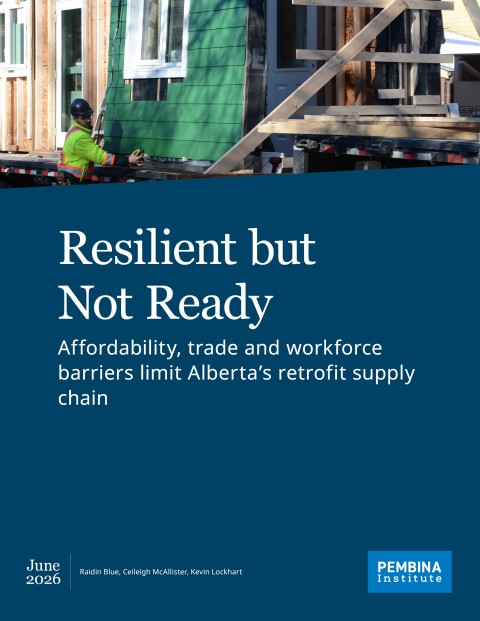
Alberta’s building retrofit sector is ready to scale and could generate $5.8 billion in GDP and support 24,000 jobs with $2.5 billion in annual investment — but only if governments, utilities, and industry align on a clear, coordinated strategy.
Resilient but Not Ready shows that while Alberta’s retrofit supply chain is adaptable and resilient, progress is being held back by a lack of coordination, long-term market signals and policy certainty. Without these, the province risks missing a major economic and affordability opportunity.
Retrofits offer a faster, lower-cost path to energy security and affordability than expanding electricity supply alone. They reduce household energy bills, lower demand on the electricity grid, and protect buildings against costly climate-related damage from hail, flooding, wind and fire.
A capable retrofit sector facing preventable barriers
The report’s central finding shows Alberta does not lack capability, it lacks coordination. Based on industry interviews, a sector survey, and market analysis, the research shows the retrofit supply chain has already proven its resilience. Companies successfully navigated recent U.S. tariffs and supply disruptions by shifting suppliers, diversifying sourcing, and working directly with manufacturers. However, the following key barriers are slowing growth:
- High upfront costs for mechanical systems like heat pumps and heat recovery chillers
- Limited availability of high-performance building materials due to lean manufacturing and long lead times
- Low inventory levels and constrained local supply
- Workforce gaps and uneven training pathways
These challenges are not simply structural limitations, they are coordination problems that can be addressed through targeted policy and market alignment.
A strategic opportunity for Alberta
As the federal government prepares to double Canada’s electricity generation over two decades through its National Electricity Strategy, the report argues Alberta already has a complementary solution at hand: scaling whole-building retrofits. Done at scale, retrofits can:
- Deliver immediate affordability benefits for households
- Reduce pressure on electricity infrastructure
- Improve resilience of homes and buildings
- Create stable, local jobs across the province
- Demonstrate coordinated action
The report calls for immediate collaboration across government, utilities, and industry to unlock this opportunity through a clear market development roadmap.
Main recommendations
- Establish a coordinated retrofit roadmap to create predictable, long-term demand
- Strengthen workforce readiness through training, recruitment, and greater diversity in trades
- Improve supply chain coordination and certainty to reduce costs and delays
- Expand domestic and regional manufacturing to reduce trade vulnerability
- Leverage export opportunities, particularly where retrofits intersect with distributed energy resources (DERs)

The Pembina Institute acknowledges the generous support of the Alberta Ecotrust Foundation.