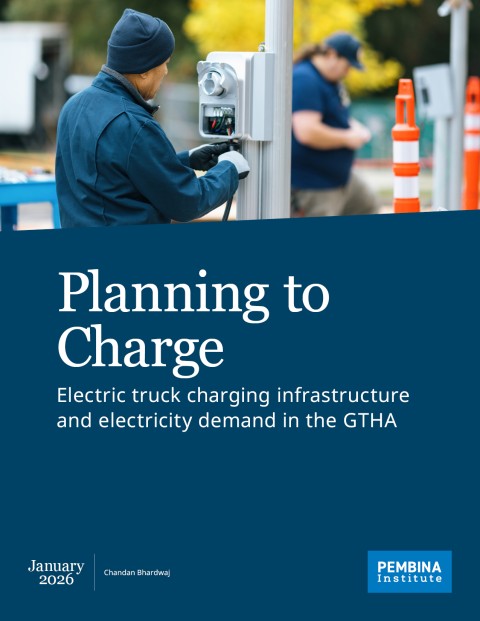
Electric trucks are growing globally, with sales increasing nearly 80% in 2024, surpassing 90,000 vehicles worldwide. Many Canadian and international studies assume all trucks electrify at the same pace, a simplification that tends to overestimate near-term electricity demand and charging infrastructure needs.
A new analysis from the Pembina Institute uses real-world truck travel data across the Greater Toronto and Hamilton Area to provide a more accurate picture. By taking a smarter, staggered approach to electrification, starting with lighter trucks, placing chargers where trucks operate and enabling shared charging across fleets, cities can save up to $1 billion in infrastructure costs by 2030.
Key findings
- Electric trucks will add only about 1.5% to Toronto’s daily electricity demand by 2030, well within the city’s normal daily electricity demand fluctuations
- Strategic planning of charger deployment can reduce total costs by 60-75% across five GTHA cities by 2030.
- Prioritizing lighter trucks, shared charging, and high-traffic locations helps align infrastructure with real demand, reducing both electricity demand and charger costs.
This study is the first Canadian analysis to estimate electric truck charging and energy needs at both the city and neighborhood level, offering actionable insights for municipalities, fleet operators and utilities.