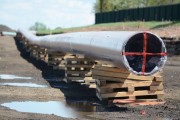
As the Enbridge Gateway oilsands pipeline proposal lurches toward the environmental assessment process, B.C. Premier Gordon Campbell is on record saying: "Enbridge has a proposal which is going through a process . . . It will include the most rigorous environmental regime there is anywhere in North America."
While it sounds nice, the reality is that the increasingly controversial pipeline will be reviewed by a Joint Review Panel established by the National Energy Board and Canadian Environmental Assessment Agency. And if the Mackenzie Gas Project is any indication, there are some very real problems with how the federal government is making decisions about major energy projects.
There's good reason opponents of the Enbridge project are wary of trusting the environmental assessment process. To illustrate why, let's look at the Joint Review Panel tasked with reviewing the Mackenzie Gas Project, a 1,300-kilometre natural gas pipeline in the Northwest Territories.
The panel consisted of seven diverse members, including four from the Northwest Territories, who spent six years conducting research and hearings before issuing 176 recommendations to mitigate harmful environmental and socio-economic effects. But guess what? Of the 115 of those recommendations directed at the federal and territorial governments, only 10 have been fully accepted.
In other words, even after a comprehensive hearing process, it appears the federal government is going to disregard the advice of its panel. And given that the panel developed these recommendations after considering the input of Aboriginal peoples, local citizens and more, this disrespect extends to them, too.
 In the case of the Enbridge Gateway oilsands pipeline, however, the situation is much worse to start off with. The Joint Review Panel only consists of three people — none of whom are from B.C. Two are from Calgary; the third is a First Nations person from northern Ontario.
So, let's get this straight: a 1,300-km natural gas pipeline project gets reviewed by a diverse seven-member panel, some of whom have a first-hand understanding of northern issues, but a twin 1,170-km oilsands pipeline (2,340 km in total), which opens B.C.'s North Coast to crude oil tankers only gets reviewed by a panel of three people with no first-hand knowledge of the region?
This is starting to sound like a bad political satire. Unfortunately, it's real life — and the consequences of rubber-stamping the Enbridge pipeline are tremendous.
While Enbridge may claim the chance of a major oil tanker spill due to this project is "minimal," keep in mind that BP also said the chance of a spill in the Gulf was "unlikely." To top it off, Enbridge ultimately bears no responsibility beyond the tanker port anyway. It's easy to make promises you don't have to keep.
Unlike BP's Deepwater Horizion rig, which was exempted from a formal environmental impact analysis, at least the Enbridge Gateway oilsands pipeline will undergo an environmental assessment, but the credibility of this assessment is starting out on shaky ground, and the panel hasn't even started its hearings yet.
Download our full comparison of the review process for the Mackenzie Gas Project and the Enbridge oilsands pipeline.