Pembina Channels:             |    Print    |    Send    |    Resize: A A A
 

Pembina Institute


Delays to U.S. climate law no excuse for Canada to stall

Action to cut greenhouse gas (GHG) emissions in the United States suffered a setback over the weekend, when it emerged that plans to unveil a bipartisan Senate climate and energy bill on Monday had been postponed. Does this spell delays for Canada too? We don't think it should.

Congress is having a hard time getting to the point of being able to pass legislation creating a cap-and-trade system for GHGs — the centrepiece of an effective national climate policy. The House of Representatives succeeded in passing a cap-and-trade bill ("Waxman-Markey") last year, but obtaining sufficient support in the Senate is more challenging.
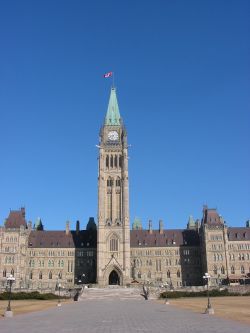
Photo: The Pembina InstituteCanada has had the legislative power to regulate greenhouse gas emissions since 2005.Canada is in a very different position from the U.S. First, the Government of Canada has had the legislative power to implement cap-and-trade since November 2005, when the Martin government added GHGs to the Canadian Environmental Protection Act (CEPA). Canada can act immediately without going through a lengthy legislative process.

Second, if there is any need to amend CEPA to provide more flexibility[1] in implementing a Canadian cap-and-trade system, there should be no difficulty in securing the support of a clear majority of legislators. For example, the three opposition parties — which form a majority in the House of Commons — recently passed a motion calling on the government to "put in place immediately a national climate change plan that implements economy-wide regulations on greenhouse gas emissions."

The Harper government has repeatedly stated that Canada cannot make decisions about our own version of cap-and-trade until U.S. policy is clear. But there is simply no political or economic justification for such an extraordinary abandonment of Canadian sovereignty. Pembina's economic modelling work indicates that Canada can indeed show leadership by putting a strong price on GHG emissions (via cap-and-trade or a carbon tax) without waiting for the U.S. A few vulnerable industry sectors would require protection — but cap-and-trade can be designed so as to provide that protection.

It's encouraging that, according to a report in yesterday's Globe and Mail, federal Environment Minister Jim Prentice now acknowledges Canada can take action to phase out emissions-intensive coal-fired electricity without waiting for the U.S. On the other hand, his predecessor John Baird showed how ministerial statements of intent (such as Minister Baird's "Turning the Corner" plan) can be abandoned long before reaching the stage of publishing the regulations needed for implementation.

The bottom line is that the Harper government had the legislative power to implement economy-wide GHG regulations the moment it took office in February 2006. More than four years later, using U.S. indecision to continue delaying those regulations just looks like an excuse for inaction.


[1] Such an amendment might be needed, for example, to enable the auctioning of emission allowances, instead of giving them to industries free of charge. Pembina believes that in a fair, transparent system, emitters should have to buy 100% of allowances at auction.

Learn more about Climate Change.

Read more blogs relating to Climate Change, Federal Action, USA.

Mark Shephard — Apr 27, 2010 - 10:12 AM MT

Why is it that we are so bound and determined as Canadians to continually penalize ourselves? I am being taxed to death in this country and I seem to be getting less and less for it. Sure lets put in a greenhouse tax so that we pay even more for electricity and watch our costs for production shoot through the roof. Thats good for trade when our partners to the south have no such costs. That makes perfect economic sense.....(if you are Canadian). Once again the dollar hit parity with the american greenback and I'm still paying more for magazines than my american counterparts do, I'm still paying 1/3 more for the same vehicle that americans buy, to the tune of tens of thousands of dollars, we were never fairly compensated for the softwood lumber tarrifs that the americans put on our imports that the world courts told them time and again that they were wrong in doing so. There are lots of examples of how were are penalized every day when dealing/trading with the US. All I want is a fair and level playing field. Yes I agree that the environment needs some attention but if the planet is really serious then all eyes should turn to places like Chile and China where the polution is so bad by mid afternoon, people need to wear masks when they are outside of their own homes. That is where massive changes need to be made and soon. We all know why more pressure isn't being put on the Chinese to make these changes, because they wont make them period. So lets put more pressure on the Canadians because as the world knows, while we might grumble about it, in the end we will just roll over like we always do and pay the price. The minisule cutbacks that we make in Canada are not worth the skyrocketing costs that we will be forced to pay when poluters like China are free and clear to continue unabated. I'm tired of paying more for less when others around the world sit back and do nothing. Enough is enough.

Matthew Bramley — Apr 27, 2010 - 01:14 PM MT

Mark:
Right now fossil-based energy is being effectively subsidized by our kids via the environmental costs that it is creating for them. The world’s major National Science Academies say it’s urgent to cut GHG emissions, and economists are virtually unanimous that we’re only going to succeed if we put a price on those emissions (e.g., with a cap-and-trade system). The good news is that the money we pay for emissions can be returned to citizens – by reducing income tax, for example.
All countries need to take action to cut emissions. China is actually doing a lot in this regard already (see http://www.nrdc.org/international/Chinacleanenergy/files/China%20Clean%2...). But the worst way to encourage China to do more is for a country like Canada – seven times more wealthy than China per person – to say “no, you go first.” Canada may have a small population but we’re still in the top 10 GHG-emitting countries in the world.
Economic studies show that even with a high price on emissions, only a few sectors would be vulnerable to major competitiveness impacts – and job creation could be as strong as under business-as-usual. Many people exaggerate the costs of cutting GHG emissions – and forget about the much greater costs of climate change itself.

Post new comment

We will not publish or share your email address.
CAPTCHA
In an effort to reduce spam abuse, we ask that you type the characters that you see below.
Image CAPTCHA
Enter the characters shown in the image.