


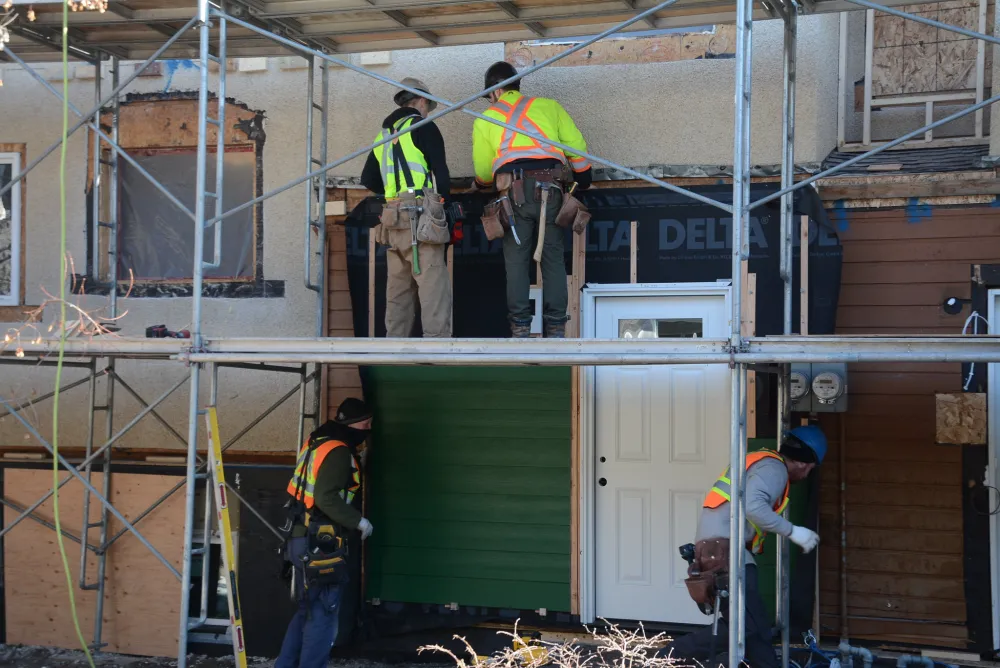
CALGARY — A new report finds a resilient but under-supported supply chain is contributing to slowing Alberta’s progress toward energy security and housing affordability. As the federal government moves to double Canada's electricity generation over two decades through its forthcoming National Electricity Strategy, this report argues Alberta already has a faster, lower-cost tool available: scaling building retrofits.
Resilient but Not Ready, released today, finds that Alberta’s retrofit supply chain is adaptable and positioned for growth — but without coordinated action on affordability, trade resilience, and workforce development, the province risks missing out on a major economic opportunity. The report’s central finding is clear: the barrier to scaling retrofits in Alberta is not capability, it’s the absence of coordination, certainty, and long-term market signals.
The report finds an annual investment of $2.5 billion in retrofits could generate $5.8 billion in GDP and support 24,000 jobs across Alberta, while cutting household energy bills and easing pressure on the electricity grid.
Retrofits lower utility costs for households, reduce demand on the electricity system, and harden buildings against costly damage from hail, wind, flooding, and fire — delivering affordability and resilience outcomes at a fraction of the cost and timeline of new electricity generation.
With ongoing uncertainty around cross-border trade, the report highlights retrofits as a way to strengthen Canada’s economic competitiveness by building domestic capacity, reducing exposure to external shocks, and positioning Alberta service providers to export retrofit solutions and technologies. The research, based on 12 industry interviews, a survey of retrofit service providers, and a comprehensive market scan, found that Alberta’s retrofit supply chain has already demonstrated resilience. Suppliers and contractors successfully navigated recent U.S. tariffs and trade disruptions by diversifying sourcing, pivoting to new distributors, and in some cases dealing directly with manufacturers.
Affordability barriers for complex mechanical equipment, including heat pumps and heat recovery chillers, are limiting uptake. Access to high-performance building enclosure products — such as insulation, recladding systems and window walls — is also constrained due to lean manufacturing, long lead times, and low local inventories. The report calls on government, utilities, and industry to immediately collaborate on a coordinated market development roadmap for whole-building retrofits.
Recommendations
- Establish a coordinated roadmap for whole-building retrofits to drive predictable, stable demand for high-performance products and equipment.
- Strengthen workforce readiness by closing occupational and skill gaps, expanding training, and improving recruitment and diversity in the trades.
- Improve supply chain coordination and market certainty to reduce affordability barriers for complex mechanical systems and enclosure products.
- Support domestic and regional manufacturing capacity for key retrofit components to reduce exposure to cross-border trade disruption.
- Leverage export opportunities, particularly where retrofits intersect with distributed energy resources (DERs).
This research is funded through Alberta Ecotrust Foundation’s Deep Energy Retrofit Accelerator program. Alberta Ecotrust funded this research to identify and minimize barriers to retrofits, aiming to reduce emissions from existing buildings in Alberta and make retrofits more attainable.
Quotes
“A business-as-usual approach will not resolve these challenges nor rise to meet the opportunity of national electrification. With targeted action, Alberta can transform a resilient but under-supported sector into a competitive economic engine, one that delivers affordability, energy security and jobs right now.”
— Kevin Lockhart, Director, Buildings program, Pembina Institute
“A key component in preparing to scale up deep retrofits is understanding what materials and skills are needed to drive mass adoption of retrofits. Understanding the supply chain is critical to unlocking the speed and quality required to undergo mass retrofits in Alberta. This work will result in numerous jobs and a significant economic output in Alberta."
— Andrea Linsky, Director, Emissions-Neutral Buildings, Alberta Ecotrust Foundation
Quick facts
- An annual investment of $2.5 billion in Alberta retrofits could return $5.8 billion in GDP per year and sustain 24,000 jobs.
- Alberta's retrofit pathway to net-zero residential buildings by 2050 relies on scaling retrofits 4-5% annually through a phased approach.
- Alberta needs to recruit approximately 25,000 additional retrofit-sector workers by 2030 to meet projected demand, with critical skill gaps in advanced HVAC, building automation, energy modelling, and renewable energy integration.
- Women make up only 8% of the on-site construction workforce; two-thirds of women in the trades work off-site, primarily in administrative and management roles.
[30]
Contact
Sarah Snowdon
Senior Comms Lead, Pembina Institute
647-797-9329