
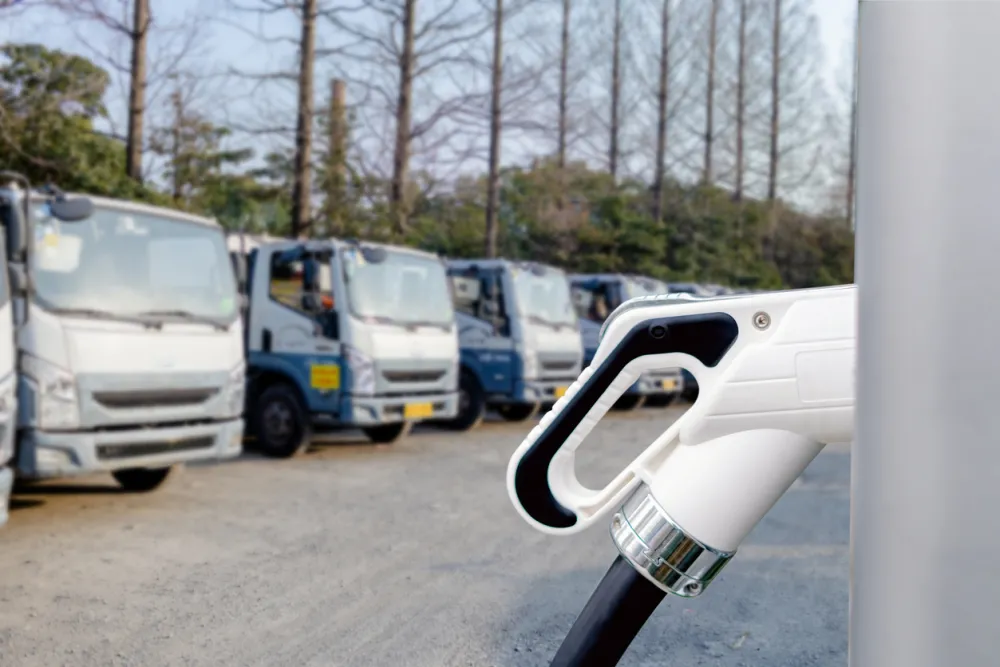
TORONTO, ON — Early planning for electric trucks is overestimating near-term electricity demand and charging infrastructure needs by assuming all truck classes electrify at the same pace.
New analysis from the Pembina Institute, Planning to Charge, draws on real-world truck travel data across the Greater Toronto and Hamilton Area and finds that many Canadian and international studies rely on this simplified assumption. In practice, it inflates projected electricity demand and charging needs, because heavier trucks require larger, more expensive chargers, while lighter trucks can electrify earlier with far lower impacts on the grid.
When electrification is led by lighter trucks, and when charging demand in planned based on where and when trucks actually operate, cities can build fewer chargers upfront, deploying them more strategically and rely less on costly fast charging.
The study shows that if Toronto reaches a 35% electric truck share by 2030, electric medium- and heavy-duty vehicles would account for less than 1.5% of current daily electricity consumption and peak demand. That increase falls well within normal day-to-day fluctuations on the grid.
At the same time, the research finds that how charging infrastructure is planned matters as much as how much is built.
By focusing early electrification on lighter trucks, targeting charger deployment to high-traffic locations, enabling shared charging across fleets and shifting more charging to overnight depot locations, cities can significantly reduce infrastructure costs without slowing adoption.
Across Toronto, Brampton, Mississauga, Hamilton and Markham, these strategies together could cut total charging infrastructure costs by 60 to 75% by 2030. That represents roughly $1 billion in cumulative investment savings.
Smart planning does not mean building less infrastructure in the long run. It means building the right infrastructure at the right time, in the right places.
The findings suggest that concerns about electric trucks overwhelming the electricity grid in the near term are overstated, and that better aligned planning can ease both cost pressures and grid impacts as adoption accelerates.
Quotes
“When planning assumes that light delivery vans and heavy long-haul trucks electrify at the same rate, it overstates near-term electricity demand and charger costs. Our analysis of real-world truck travel data shows that early electrification is led by lighter trucks, which require far less charging power. That distinction has major implications for how municipalities and utilities plan grid investment today.”
— Chandan Bhardwaj, Senior Analyst, Transportation, Pembina Institute
“Electric truck charging infrastructure will need to expand, but our analysis shows it doesn’t have to happen all at once or at the highest cost. The scale, timing and grid impacts of that buildout are shaped by planning decisions, including which trucks electrify first and where chargers are installed.”
— Adam Thorn, Director, Transportation, Pembina Institute
Quick facts
- This is the first Canadian study to estimate electric truck charging and electricity needs at both city and neighbourhood levels using real-world anonymized truck data.
- Even under ambitious adoption scenarios, electric trucks would add less than 1.5% to Toronto’s daily electricity consumption and peak demand by 2030.
- Toronto’s hourly electricity demand can fluctuate by more than 25% in a single day.
- Smart planning and targeted charging strategies could cut infrastructure costs by up to 75%, saving about $1 billion across five GTHA cities by 2030.
- About 10% of neighbourhoods account for more than half of electric truck energy demand and charger needs.
[30]
Download a copy of Planning to Charge: Electric truck charging infrastructure and electricity demand in the GTHA
Contact
Lejla Latifovic
Senior Communications Lead, Pembina Institute
819-639-4185
Background
Report: Locating Charging Stations
Report: Electrifying Fleet Trucks
Blog: Powering Canada’s freight future
Blog: Ontario is ready for electric trucks
Report: Helping Fleets Charge: Barriers and solutions to charging electric medium- and heavy-duty vehicles in Ontario