
I was flying over the Gulf of Mexico when I first learned about British Petroleum's Deepwater Horizon oil spill. At 30,000 feet from my plane window the oil spill looked something like a tailings pond surrounded by an ocean of blue. As anyone who is following the news coverage knows, this small pond of oil has spread into what may be the worst environmental disaster of this century and it will turn into quite the economic disaster as well.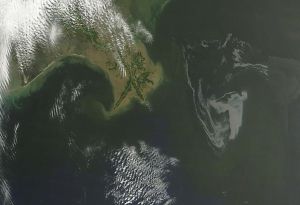 Gulf of Mexico oil slick image acquired from Nasa, May 1, 2010
The Deepwater Horizon oil spill, with its more than six million litres of oil spewed into the Gulf of Mexico, is not an unlikely event. In fact, there have been a number of these spills in recent years. In the past 20 years there have been 11 major ocean-based oil spills. On a smaller scale, Environment Canada recently reported that there are 12 or more oil spills every day in this country.
The legacy of oils spills and their economic costs suggests that the growing oil spill in the Gulf of Mexico is going to be very costly. For comparison, the largest two oil spills in the last two decades cost companies and taxpayers millions and sometimes billions of dollars.
In 1989, the Exxon Valdez spill dumped some 40 million litres of oil onto the Alaskan coastline. A report by Resources for the Future, an independent research institute b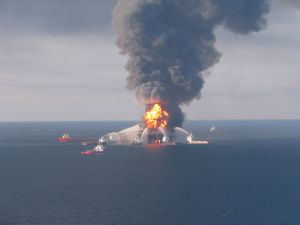 ased in Washington, D.C., shows that U.S. courts initially awarded punitive damages of $5 billion CDN (which they appealed and paid $507 million of the total punitive charge), forced Exxon to pay $2.1 billion in clean-up costs and $1 billion in natural resource damages.
In 2002, the Prestige oil spill dumped 75 million litres onto the coast of Spain and FranceDeepwater Horizon blowout, April 2010. Photo courtesy of the U.S. Coast Guard. destroying thousands of beaches and the local fishing industry. According to a 2006 study, the clean up costs were estimated at more than $3.3 billion CDN. The annual cost to the local fishery and the local tourism industries was estimated at more than $73 million and $133 million CDN, respectively immediately following the oil spill.
Since the Exxon Valdez spill, environmental a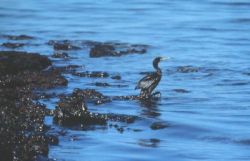 Bird struggles after Exxon Valdez oil spill, March 1989. Photo credit: Creative Commons.nd ecological economists have been working to estimate the total damages associated with these types of environmental catastrophes. From this research we know that the price tag associated with the Deepwater Horizon spill is likely to be even higher than the Exxon Valdez or the Prestige. While President Obama has made it clear British Petroleum will pay, the coastal and marine environment along the Gulf of Mexico will ultimately bear the costs for months and years to come.
It can be safely assumed that the clean up costs and damages to the environment and economy from the Deepwater Horizon oil-spill will be in the billions. As we consider the weight of the devastation brought about by such largehuman-caused disasters (even though BP is saying they are not responsible) we should keep in mind that these costs are avoidable.
After seeing television pictures of the Gulf of Mexico spill, California Governor Arnold Schwarznegger withdrew his support for offshore oil developments.
When you factor in the real costs of oil development, it means I should have to pay a lot more to fly 30,000 feet above the Gulf of Mexico. It means we need strong leadership on energy issues. Here in Alberta, it means that we should watch the oilsands with a critical eye for the potential environmental and economic devastation of further wildlife deaths, leaching from the tailings ponds or worse, the collapse of a tailings pond embankment. No one ever predicts these accidents occurring until they do, and then we're left with the environmental and economic costs.
The economics of an oil spill
May 4, 2010
Article
Tags:
Related Research & Analysis





Programs
Leading the transition to clean energy requires solutions to today’s energy challenges from various angles.
The Pembina Institute has spent four decades working to reduce the environmental impacts of Canada’s energy production and provide actionable ideas on how to implement clean energy.